The 50/30/20 Budgeting Rule: A Practical Guide to Managing Your Money
You Earn Money Every Month. But Where Does It Go?
Have you ever looked at your bank balance towards the end of the month and wondered how your paycheck disappeared so quickly?
You received your salary, paid the rent, bought groceries, cleared a few bills, perhaps ordered dinner a couple of times and made a few online purchases. Nothing seemed particularly extravagant. Yet, when you look at what remains, your savings are considerably smaller than you expected.
It is a familiar situation for many working professionals.
The interesting thing is that managing money is not necessarily about giving up everything you enjoy or finding ways to save every last dollar. It is about understanding your spending habits and making conscious decisions about where your income goes.
Think about it: two people earning exactly the same salary can have very different financial outcomes. One might save consistently, while the other struggles to set aside even a small amount. The difference is not always income. Sometimes, it is simply how they organise their finances.
This brings us to one of the most widely discussed personal finance concepts: the 50/30/20 budgeting rule.
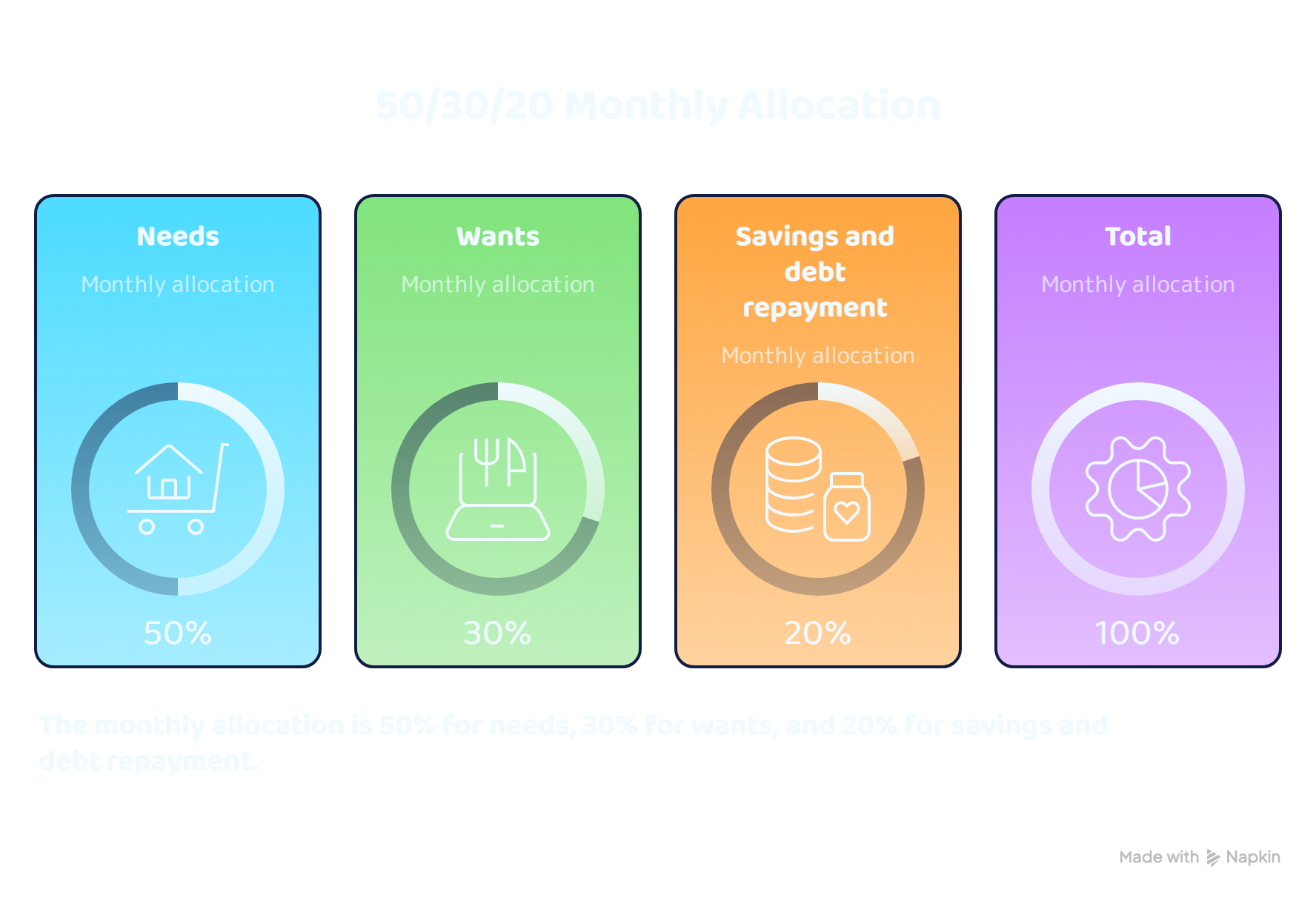
The principle is straightforward. Allocate 50% of your take-home income to needs, 30% to wants and 20% to savings and debt repayment.
It sounds simple enough. But does it work when rent consumes a large part of your salary? What if you have children, outstanding loans or an unpredictable income?
Let’s examine the rule, put it into practice and understand where it works, where it falls short and how you can make it work for your circumstances.
1. What Is the 50/30/20 Budgeting Rule?
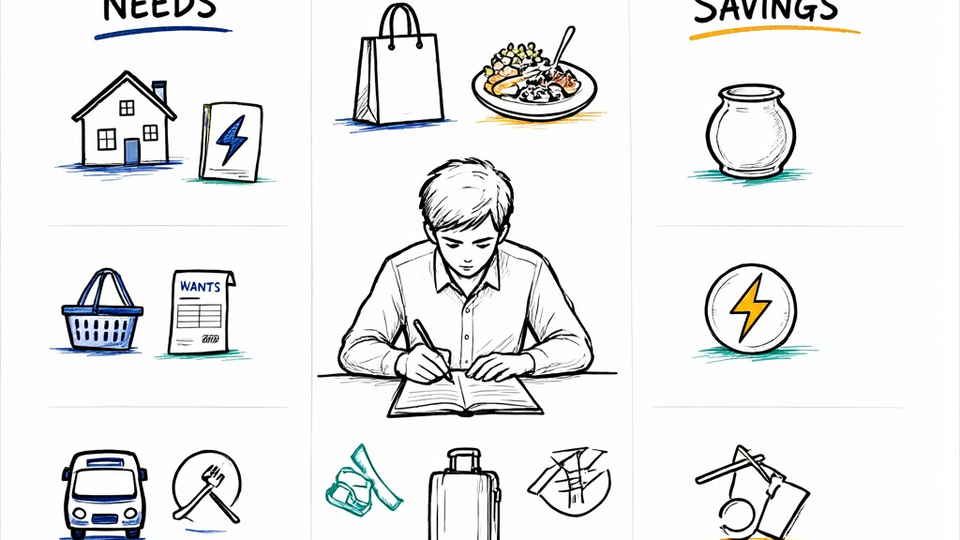
The 50/30/20 budgeting rule is a simple method of organising personal finances by dividing after-tax income into three broad categories:
- 50% for needs: Essential expenses required for everyday living.
- 30% for wants: Non-essential purchases and lifestyle expenses.
- 20% for savings and debt repayment: Money allocated towards financial security and future goals.
The approach was popularised by U.S. Senator Elizabeth Warren and her daughter Amelia Warren Tyagi in their book All Your Worth: The Ultimate Lifetime Money Plan.
The idea is to establish a balance between meeting present financial obligations, enjoying your income and preparing for the future.
Rather than tracking every purchase under dozens of expense headings, you can begin with three broad spending categories.
Here is what the allocation looks like:
| Category | Percentage | Purpose |
|---|---|---|
| Needs | 50% | Essential living expenses |
| Wants | 30% | Lifestyle and discretionary spending |
| Savings and debt repayment | 20% | Financial security and future goals |
| Total | 100% |
One important point: the percentages are guidelines, not compulsory spending limits. Your budget should reflect your income, location, household responsibilities and financial priorities.
2. Understanding the Three Categories
A. Needs: Where Does Half Your Income Go?
Needs are expenses that are essential to maintaining your basic standard of living. These are generally difficult to eliminate without affecting your housing, health, safety or ability to earn an income.
Typical examples include:
- Rent or mortgage payments
- Groceries and essential household supplies
- Electricity, water and heating
- Basic transportation to work
- Essential insurance premiums
- Healthcare expenses
- Childcare costs
- Minimum contractual debt payments
Let’s consider transportation.
If you need a vehicle to commute to work because public transport is unavailable, the basic cost of maintaining that vehicle may be a necessity. However, purchasing an expensive luxury vehicle when a more affordable option would meet the same requirement involves a lifestyle choice.
The distinction matters because the same expense category can contain both essential and discretionary elements.
A useful question to ask is: Am I paying for something I genuinely need, or am I paying extra for convenience, comfort or an upgrade?
That small distinction can reveal opportunities to manage spending without compromising essential needs.
B. Wants: Is Your Lifestyle Taking More Than You Think?
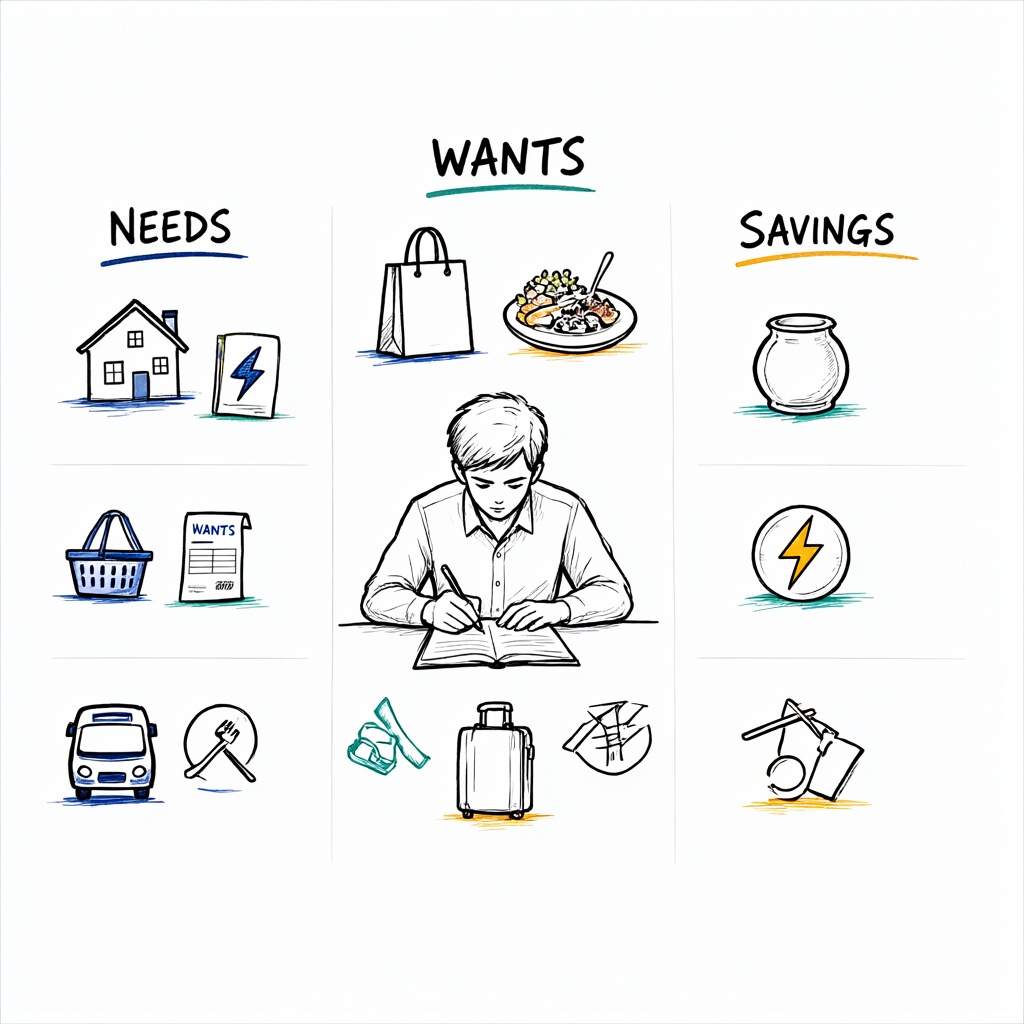
Wants are expenses that make life enjoyable but are not essential for basic living.
There is nothing wrong with spending money on entertainment, hobbies, dining out or holidays. In fact, a sustainable budget should leave room for enjoyment.
The problem arises when discretionary spending gradually becomes a larger part of monthly expenses than intended.
Consider these examples:
- Ordering restaurant meals instead of cooking at home.
- Paying for multiple entertainment subscriptions.
- Buying new clothes when existing ones are perfectly usable.
- Upgrading a smartphone before the current one needs replacing.
- Taking frequent holidays without planning for their cost.
- Purchasing items simply because they are discounted.
A discount does not automatically make a purchase a saving. Spending $80 on something you did not need is still an $80 expense, even if its original price was $120.
This is where understanding needs versus wants becomes important.
The 30% allocation is not an instruction to spend the entire amount. If you enjoy a simpler lifestyle, you can redirect some of it towards savings.
C. Savings and Debt Repayment: Preparing for Tomorrow
The remaining 20% is intended to strengthen your financial position.
It can include:
- Emergency fund contributions
- Retirement savings
- Long-term investments
- Savings for education
- Contributions towards major future purchases
- Additional repayments on outstanding debt
Imagine an unexpected medical bill, a period without employment or an urgent home repair. Without accessible savings, even a relatively small financial setback can force you to borrow money.
An emergency fund provides a financial cushion against such situations.
If you are carrying high-interest credit card debt, reducing that balance may also deserve priority. The interest you pay can make it harder to build wealth over time.
However, savings and investments are not interchangeable. Money needed for emergencies should generally remain accessible, while long-term investments should be selected according to your time horizon and risk tolerance.
The objective is not simply to accumulate money. It is to prepare for financial needs at different stages of life.
3. How Does the 50/30/20 Rule Work? A Practical Example
Let’s put the percentages into perspective.
Imagine Alex, a working professional earning $4,000 per month after taxes.
Alex wants to save consistently but also enjoys dining out, travelling occasionally and spending on hobbies.
Under the 50/30/20 framework, the monthly allocation would be:
| Category | Allocation | Amount |
|---|---|---|
| Needs | 50% | $2,000 |
| Wants | 30% | $1,200 |
| Savings and debt repayment | 20% | $800 |
| Total | 100% | $4,000 |
Now consider how this could translate into monthly expenses.
Needs
| Expense | Amount |
|---|---|
| Rent | $1,100 |
| Groceries | $400 |
| Utilities | $150 |
| Transportation | $200 |
| Essential insurance | $150 |
| Total | $2,000 |
Wants
| Expense | Amount |
|---|---|
| Dining and entertainment | $350 |
| Shopping | $250 |
| Subscriptions and hobbies | $150 |
| Leisure and outings | $250 |
| Other discretionary spending | $200 |
| Total | $1,200 |
Savings and debt repayment
| Financial goal | Amount |
|---|---|
| Emergency savings | $300 |
| Retirement savings | $300 |
| Additional debt repayment or other goals | $200 |
| Total | $800 |
This is an illustrative budget rather than a recommended spending pattern for every household.
What makes the exercise useful is that it converts an abstract percentage into actual financial decisions.
For instance, if Alex spends $1,500 on rent instead of $1,100, the remaining allocation for essential expenses becomes tighter. That may require adjusting other categories rather than simply assuming the original formula will work.
A budget becomes useful when it reflects what actually happens to your money, not just what you intend to happen.
4. How Can You Start Following the 50/30/20 Budgeting Rule?
You do not need complicated financial software or an elaborate spreadsheet to get started. A basic understanding of your income and expenses is enough.
Here is how I would approach it.
Step 1: Start with your take-home income
First, calculate the money available to you after taxes and mandatory payroll deductions.
For example, if your gross monthly salary is $5,000 but your take-home pay is $4,000, calculate the percentages using $4,000.
This is important because budgeting with money you never actually receive can give you an unrealistic picture of your spending capacity.
Step 2: Understand where your money currently goes
Before setting targets, review your bank statements, credit card transactions and recurring payments.
Look at the previous one or two months and classify your expenses into needs, wants and savings.
You may discover that you are spending more than expected on subscriptions, restaurant meals or small online purchases.
The Consumer Financial Protection Bureau recommends tracking spending to understand how much of take-home income goes towards different categories.
Step 3: Set realistic spending limits
Once you understand your current spending, calculate your target allocations.
For someone earning $5,000 per month after taxes, the suggested amounts would be:
- $2,500 for needs.
- $1,500 for wants.
- $1,000 for savings and debt repayment.
Use these figures as reference points, not rigid restrictions.
Step 4: Automate your savings
One practical strategy is to transfer a predetermined amount into a separate savings account when your paycheck arrives.
If your monthly savings target is $1,000, an automatic transfer can help ensure that the money is allocated before discretionary spending begins.
As the familiar saying goes, “Don’t save what is left after spending; spend what is left after saving.”
Step 5: Review your budget every month
Your financial circumstances will change.
You might move to a more expensive apartment, receive a salary increase, take on additional family responsibilities or begin repaying a loan.
Review your allocations regularly and make adjustments when necessary.
A budget should evolve with your life.
5. What Are the Advantages of the 50/30/20 Budgeting Rule?
The popularity of this method comes largely from its simplicity.
It makes budgeting less complicated. Instead of tracking numerous expense categories, you begin with three broad spending groups.
It encourages regular saving. By assigning a portion of income to future goals, you are less likely to treat saving as something that happens only when money remains.
It allows room for enjoyment. The allocation for wants recognises that financial well-being is not just about accumulating money. It is also about enjoying the present responsibly.
It helps identify spending habits. Categorising expenses can reveal where money is being spent unnecessarily.
It provides a starting point for financial planning. The framework can help beginners develop a more structured approach to managing income.
6. Why Doesn’t the 50/30/20 Rule Work for Everyone?
Here is where the discussion becomes interesting.
A budgeting formula may look perfect on paper but prove difficult to follow in real life.
Consider someone earning $4,000 per month in a city where rent alone costs $1,600.
That is already 40% of take-home income. Once groceries, transportation, utilities and insurance are included, essential expenses may easily exceed the recommended 50%.
Does that mean the individual is financially irresponsible?
Not necessarily.
The cost of living, household responsibilities and income levels can make a significant difference.
The Consumer Financial Protection Bureau itself acknowledges that not everyone can follow the 50/30/20 guideline and encourages individuals to develop spending rules suited to their circumstances.
Here are some situations where the standard allocation may need adjustment.
High housing costs
Housing is often one of the largest household expenses. People living in expensive cities may find it difficult to keep rent or mortgage payments, utilities and other essentials within half their take-home income.
Lower household income
When income is limited, essential expenses can consume most of the available money. Expecting someone to save 20% while struggling to cover basic necessities may be unrealistic.
Irregular earnings
Freelancers, consultants, contractors and commission-based employees may not receive the same income every month.
They may benefit from budgeting around actual income received and maintaining a cash reserve for lower-income periods.
Significant debt obligations
Someone with high-interest debt may need to allocate more money towards repayment. In such cases, the standard 20% allocation may not be sufficient.
The important thing is to understand why your budget differs from the guideline and make a conscious plan to improve it.
7. What Does Financial Research Tell Us About Budgeting?
The 50/30/20 rule is a practical guideline, not a scientifically established formula that guarantees financial success.
However, research and financial education resources offer useful insights into why budgeting matters.
The Consumer Financial Protection Bureau’s perspective
The Consumer Financial Protection Bureau (CFPB) provides educational resources on budgeting and personal financial management.
Its budgeting guidance explains the 50/30/20 allocation but also makes an important qualification: people should develop their own spending rules according to their financial circumstances.
Its consumer worksheet encourages individuals to track spending, identify needs and wants, and establish personal spending limits.
This is a valuable distinction. A financial rule should help people make decisions, not make them feel that they have failed when their circumstances differ from the recommended percentages.
Read more: CFPB – My Spending Rule to Live By
What can we learn from real-world budgeting experiences?

Online personal finance discussions reveal a recurring concern: essential expenses, particularly housing and transportation, can make the 50% allocation difficult to achieve.
For example, in a discussion on Reddit’s r/personalfinance, a person earning approximately $4,600 per month after taxes questioned whether the guideline was realistic after accounting for rent, utilities, groceries and transportation.
Another discussion in r/PocketGuard described a person whose essential expenses consumed approximately 67% of take-home income, despite trying to follow the rule.
These discussions highlight an important issue: a percentage-based budgeting method cannot eliminate the effect of high living costs.
Read the discussions:
- Reddit: Is the 50/30/20 budgeting guideline realistic?
- Reddit: What happens when essential expenses exceed 50%?
My takeaway is that the value of a budget lies in the financial awareness it creates. Even if your actual allocation is 65/20/15, understanding why it looks that way is a useful first step towards improving it.
8. Frequently Asked Questions About the 50/30/20 Budgeting Rule
What is the 50/30/20 budgeting rule in simple terms?
It is a budgeting method that allocates 50% of take-home income to needs, 30% to wants and 20% to savings and debt repayment.
Should I use gross income or take-home income?
Use take-home income after taxes and mandatory payroll deductions. This is the money available for your monthly spending and saving decisions.
Can I save more than 20% of my income?
Yes. The 20% allocation is a guideline, not a maximum. If your essential expenses are manageable and you have fewer discretionary expenses, you can save more.
What if my rent alone takes up 40% of my salary?
You may need to adjust your allocations. Review other essential expenses, discretionary spending and housing options where practical. Do not assume that you have failed simply because your housing costs exceed the guideline.
Should debt repayment be included in the 20% allocation?
Additional debt repayment can be included in this category. However, minimum contractual payments should also be accounted for when planning your essential monthly obligations. High-interest debt may justify prioritising additional repayments.
Is the 50/30/20 rule suitable for families?
It can be a useful starting point, but families may have additional costs such as childcare, healthcare, education and housing. These responsibilities may require a different allocation.
Is the 50/30/20 rule better than zero-based budgeting?
Neither method is universally better. The 50/30/20 rule is simpler and uses broad percentages. Zero-based budgeting assigns every dollar to a specific purpose. The better method is the one you can consistently maintain.
What should I do if my income changes every month?
Calculate your budget using actual income received. Consider maintaining a cash buffer to cover essential expenses during months when earnings are lower.
Conclusion: Your Budget Should Reflect Your Life
The 50/30/20 budgeting rule offers a useful starting point for organising personal finances. It encourages people to distinguish between essential expenses, lifestyle spending and financial goals.
But a budgeting method should never become a source of unnecessary pressure.
Someone paying high rent, supporting a family or managing significant debt may not be able to follow the suggested percentages. That does not mean budgeting is pointless. It simply means the financial plan needs to reflect reality.
Start by understanding where your money goes. Identify the expenses you can control, prioritise your financial goals and make adjustments as your circumstances change.
You do not have to get every percentage right from the first month.
The best budget is not the one that looks perfect on paper. It is the one that helps you make better financial decisions, month after month.
After all, the purpose of managing money is not merely to make it last until the next paycheck. It is to give yourself greater control over the choices you can make in the future.
Further Reading and Research
- Consumer Financial Protection Bureau – My Spending Rule to Live By
- Consumer Financial Protection Bureau – Analyzing Budgets
- Consumer Financial Protection Bureau – Consumer Voices on Financial Rules to Live By
- Reddit – Personal Finance: 50/30/20 Budgeting Discussion
- Reddit – PocketGuard: Essential Expenses and Budgeting
Disclaimer: This article is for general educational purposes and does not constitute individual financial advice.