


Loan Origination System Workflow: 7 Key Steps, Benefits and Real-World Examples
Imagine applying for a home loan. You submit an application, provide income documents, share bank statements and wait for the lender’s decision.
But what happens after you submit the application?
Behind the scenes, several activities take place. The lender verifies your documents, examines your income and existing financial obligations, evaluates your creditworthiness and reviews the application before making a decision.
Now imagine a bank processing thousands of loan applications every month.
Managing these activities through spreadsheets, emails and disconnected systems can quickly become difficult. Documents may be misplaced, information may need to be entered repeatedly, and applications can remain pending while waiting for verification or approval.
This is where a Loan Origination System (LOS) becomes important.
An LOS helps lenders organise and manage the journey from loan application to approval and, depending on the platform, disbursement. It connects information, people and processes so that applications can move through the lending lifecycle in a structured way.
But how does a loan origination system actually work? What happens at each stage? And how are banks and financial institutions using this technology in the real world?
Let’s explore.
What Is a Loan Origination System?
A Loan Origination System (LOS) is a software platform that helps banks, non-banking financial companies (NBFCs), credit unions and other lenders manage the process of receiving, evaluating and processing loan applications.
Instead of managing each stage separately, an LOS can bring several lending activities into a connected workflow.
Depending on the platform and its configuration, these activities may include:
- Capturing borrower applications
- Collecting customer information and documents
- Performing identity and document verification
- Retrieving credit bureau information
- Supporting credit assessment and underwriting
- Routing applications for approval
- Generating loan documentation
- Coordinating loan disbursement
An LOS does not necessarily approve every loan automatically. It may support automated checks and workflow routing while credit officers and authorised approvers remain responsible for reviewing important lending decisions.
The objective is to make loan processing more organised, traceable and efficient.
How Does a Loan Origination System Work?
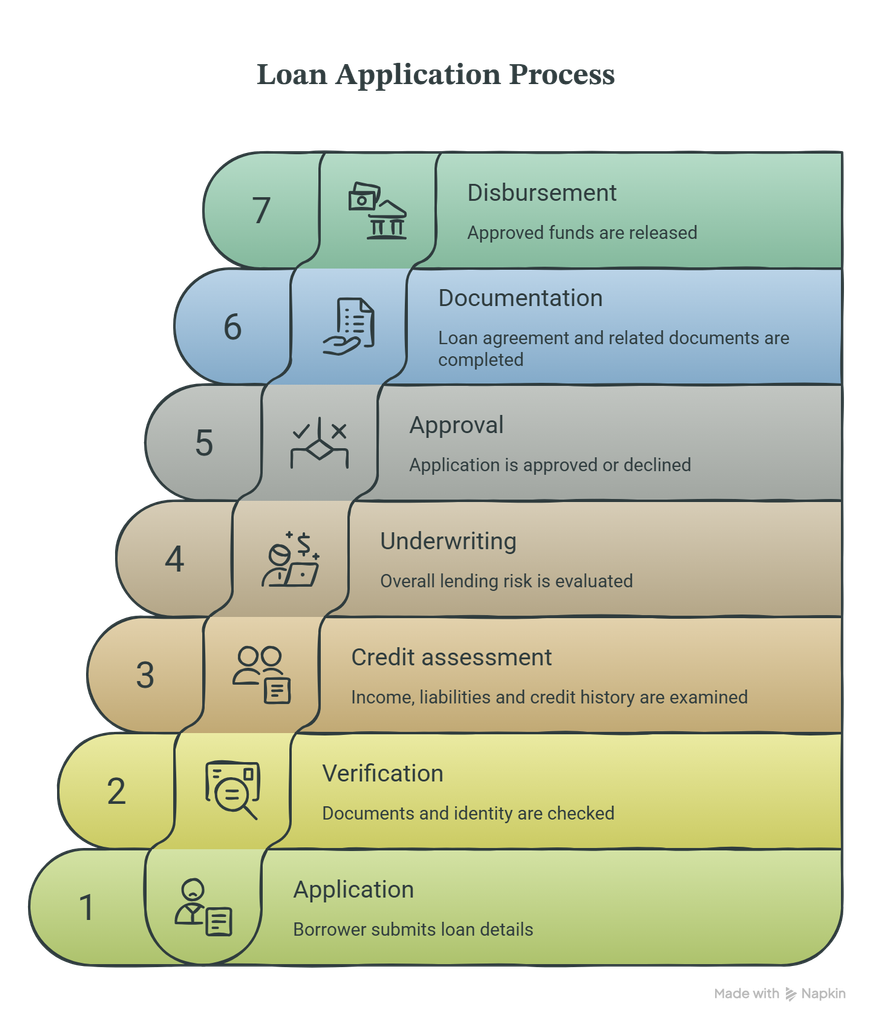
A typical loan origination system workflow involves seven key stages. The exact process varies according to the lender, loan product, credit policy and regulatory requirements.
Consider a hypothetical customer applying for a home loan. Here is how the application may move through the lending process.
The seven stages at a glance
| Stage | What happens? | Teams commonly involved |
|---|---|---|
| 1. Application | Borrower submits loan details | Sales / onboarding |
| 2. Verification | Documents and identity are checked | Operations |
| 3. Credit assessment | Income, liabilities and credit history are examined | Credit team |
| 4. Underwriting | Overall lending risk is evaluated | Underwriters |
| 5. Approval | Application is approved or declined | Authorised approvers |
| 6. Documentation | Loan agreement and related documents are completed | Operations / legal |
| 7. Disbursement | Approved funds are released | Disbursement / banking operations |
1. Loan Application and Customer Onboarding
The process begins when a customer applies for a loan.
The application may come through a bank branch, website, mobile application, relationship manager or lending partner.
The lender collects information such as:
- Applicant’s name and contact details
- Loan amount and purpose
- Employment or business details
- Income information
- Residential address
- Co-applicant or guarantor details, where applicable
The LOS records the application and generates a reference number to help track its progress.
Some systems also support digital onboarding, allowing customers to enter information and upload documents without visiting a branch.
Practical example: A bank receives 500 personal loan applications through its website and branches. Instead of manually distributing the applications through emails, the LOS can capture them in one place and route them to the appropriate processing teams.
Why it matters: Accurate information at the beginning reduces avoidable follow-ups and creates a more organised application process.
2. Document Collection and Verification
After registering the application, the lender collects the documents required to evaluate the borrower.
The requirements depend on the loan product and the applicant’s profile.
| Loan category | Common document requirements |
|---|---|
| Personal loan | Identity proof, salary slips and bank statements |
| Home loan | Income documents, bank statements and property papers |
| Business loan | Financial statements, bank statements and business registration |
| Vehicle loan | Identity proof, income documents and vehicle details |
The LOS can organise uploaded documents, track pending items and record verification status.
Some platforms integrate with identity verification providers, document-reading technology and external information sources.
For example, document extraction technology may identify details from a salary slip or bank statement. However, extracted information may still need validation, especially when documents are unclear or contain inconsistencies.
Why it matters: A structured document workflow makes it easier for operations and credit teams to identify missing information before the application moves forward.
3. Credit Assessment and Eligibility Evaluation
This is where the lender begins examining whether the borrower meets the eligibility requirements.
A credit assessment involves more than checking whether someone has a regular income. The lender needs to understand the applicant’s financial position and ability to repay the proposed loan.
Depending on the loan product, the assessment may consider:
- Credit history and repayment behaviour
- Monthly income
- Existing loan obligations
- Employment or business stability
- Bank statement transactions
- Debt-to-income or fixed-obligation-to-income measures
- Collateral and property details, where relevant
A practical home-loan example
Suppose a salaried individual applies for a home loan.
The applicant earns a regular monthly salary but also has an existing car loan and personal loan.
The lender needs to evaluate how these existing obligations affect the applicant’s repayment capacity.
A high income alone does not automatically mean the borrower qualifies for the requested loan amount.
An LOS may retrieve information from connected systems and make it available to the credit team for assessment.
Why it matters: Credit assessment helps lenders understand the borrower’s financial position before making a lending decision.
4. Credit Underwriting and Risk Evaluation
Credit assessment and credit underwriting are closely connected, but they serve different purposes within the lending process.
Credit assessment involves examining the borrower’s financial information and credit profile. Underwriting brings the available information together to evaluate the overall lending risk against the institution’s credit policy.
For a home loan, an underwriter may examine:
- Income and repayment capacity
- Existing financial obligations
- Credit history
- Property valuation
- Loan-to-value (LTV) ratio
- Legal and technical documentation
- Policy deviations and exceptions
Consider a borrower who has a stable income but applies for a loan amount that is high in relation to the property’s value.
The underwriter may need to examine the requested amount, property valuation, repayment capacity and applicable lending policy before recommending a decision.
An LOS can support this process by organising documents, presenting relevant information, applying configured rules and routing exceptions to the appropriate authority.
Some lenders also integrate separate credit decision engines and risk assessment platforms with their LOS.
Automation does not eliminate the need for human judgement in every case. Complex applications, exceptions and policy deviations may still require manual review.
Why it matters: Underwriting helps ensure that lending decisions are evaluated consistently and in accordance with the lender’s risk appetite and credit policy.
5. Loan Approval or Rejection
After assessment and underwriting, the application moves to the approval stage.
The level of approval required depends on the loan amount, product and internal credit policy.
For example:
- Applications within predefined limits may be reviewed by an authorised credit officer.
- Higher-value applications may require senior approval.
- Applications involving policy deviations may require additional review.
An LOS can route applications to the appropriate approvers and record the decision.
Possible outcomes include approved, rejected, referred for further review, returned for additional information or approved subject to specified conditions.
Once approved, the lender communicates the relevant loan terms and conditions to the borrower.
Why it matters: A structured approval workflow helps establish accountability and makes it easier to track pending decisions.
6. Loan Documentation and Agreement Execution
Once the loan is approved, the lender prepares the required documentation.
Depending on the loan product, this may include:
- Sanction letter
- Loan agreement
- Repayment schedule
- Security or collateral documents
- Required disclosures
- Supporting declarations and undertakings
An LOS may support document generation, status tracking and electronic signing through integrations.
For a home loan, for example, the lender may need to ensure that the required property documents, legal checks and sanction conditions have been completed before proceeding.
Why it matters: Proper documentation ensures that the approved loan terms are recorded and the necessary formalities are completed.
7. Loan Disbursement
Disbursement is the stage at which the lender releases the approved loan amount after the required conditions have been fulfilled.
Before releasing the funds, the lender may need to:
- Confirm completion of sanction conditions
- Verify beneficiary details
- Finalise the disbursement amount
- Generate disbursement instructions
- Complete required checks
- Record the transaction
An LOS may integrate with core banking, payment or other internal systems to coordinate this process.
For a home loan, funds may be released in stages depending on the property and construction arrangements.
After disbursement, the loan generally moves into the servicing stage, where repayment schedules, interest calculations, collections and account maintenance are managed.
This is where the distinction between a Loan Origination System and a Loan Management System becomes important.
LOS vs LMS: What Is the Difference?
A Loan Origination System and a Loan Management System support different parts of the lending lifecycle.
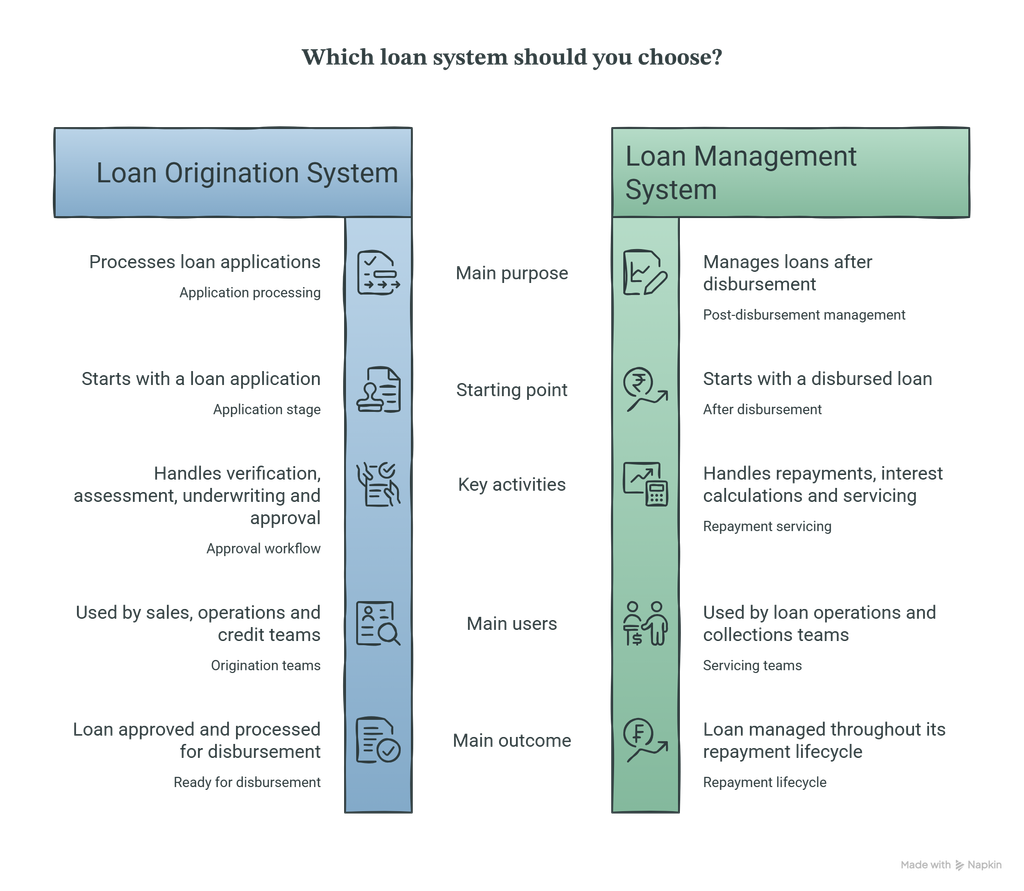
The two systems may be integrated or provided as modules within a broader lending platform. Their responsibilities depend on the software architecture and the lender’s operating model.
Real-World Examples: How Lenders Use Loan Origination Technology
The value of an LOS becomes clearer when we examine the problems financial institutions face in their actual lending operations.
Banks and lenders in have invested in digital lending platforms, workflow automation and LOS modernisation to address different challenges.
1. Digital Transformation at a Public Sector Bank
A KPMG case study on a leading Indian public sector bank describes a transformation programme designed to improve lending processes across retail, MSME and agricultural products.
The bank’s traditional processes involved physical forms, document collection and branch visits, increasing customer turnaround time.
The digital transformation programme reported:
- Approximately 50% reduction in lead-to-disbursement turnaround time.
- 65% of retail loans and 46% of MSME loans sanctioned through digital channels.
- Pre-approved digital journeys that could be completed in under two minutes for eligible customers.
The takeaway: A bank processing multiple loan categories needs workflows that can accommodate different customer profiles and documentation requirements. Digital origination journeys can help connect these activities and improve application visibility.
2. Digital Affordable Housing Finance
A Bajaj Tech.AI case study on secured lending describes an LOS implementation for a home finance company serving the affordable housing segment.
The lender faced challenges with manual processes, customer assessment, document verification and disbursement delays.
The solution included:
- Digital KYC and video KYC
- Income and bank verification
- Credit bureau integration
- Income assessment
- Manual verification workflows
- Rule-based credit decisioning
- Application tracking and disbursement support
The takeaway: Borrowers may have different income profiles and documentation needs. An LOS can help organise the information and route applications to the appropriate credit and operations teams.
3. Improving MSME Loan Processing
Small and medium-sized businesses often require financing for working capital, equipment, expansion and day-to-day operations.
However, evaluating an MSME application can involve several financial and operational checks.
A Bajaj Tech.AI case study on MSME lending describes an LOS solution supporting digital KYC, credit scoring, fraud risk management, collateral assessment, financial analysis and automated underwriting.
Consider this example: A small manufacturing business applies for a working capital loan. The lender may need to examine business turnover, bank statement transactions, existing borrowing, repayment history, financial statements and collateral, where applicable.
An LOS can help organise the application and connect relevant verification and decision-support processes.
The takeaway: MSME lending requires more than a basic application form. Lenders need a structured way to collect financial information, assess business risk and manage supporting documents.
4. Atlantic Federal Credit Union Improves Consumer Lending
Atlantic Federal Credit Union in New Jersey implemented MANTL Loan Origination to create a more streamlined digital consumer lending journey.
According to the published MANTL case study, the credit union:
- Reduced consumer loan account opening time from as long as two days to six minutes.
- Achieved an 80% submission rate for personal loan applications.
- Eliminated document collection for 67% of personal loans booked during the reported period.
- Re-engaged 80% of abandoned applications through automated reminders.
The takeaway: The borrower experience is an important part of loan origination. Reducing friction during onboarding can help lenders improve application completion and reduce unnecessary manual work.
5. Federal Credit Union Consolidates Lending Platforms
A+ Federal Credit Union in Austin, Texas, had six different platforms supporting its loan origination processes.
This created inconsistent experiences for employees and members.
The credit union adopted MeridianLink One to consolidate consumer and mortgage lending processes.
The MeridianLink case study describes how the platform supported digital lending, workflow automation, decisioning, reporting and communication.
The takeaway: As financial institutions expand their lending products, managing multiple disconnected systems can become increasingly difficult. A more unified platform can help create consistent processes and improve application visibility.
6. SWBC Mortgage Moves Towards Digital Applications
SWBC Mortgage wanted to reduce dependence on paper-heavy mortgage application processes.
The company partnered with Blend to introduce a digital mortgage experience across its branches.
The Blend case study reported:
- A 28% reduction in loan cycle time during the pilot phase.
- National rollout completed in less than four months.
- Integration with its existing Encompass mortgage LOS.
The takeaway: Digital applications can make it easier for borrowers to submit information and documents. Integration with an existing LOS can help lenders improve the customer journey without necessarily replacing their entire origination platform.
7. A Bank Builds a Digital Platform for Solar Financing
Loan origination technology is not restricted to personal loans, home loans and vehicle financing.
A Persistent Systems case study describes a digital lending platform developed for a mid-sized US bank entering the solar financing market.
The platform connected borrowers, contractors and bank underwriters.
Its capabilities included:
- Credit prequalification
- Credit decisioning
- Loan documentation
- Electronic signatures
- Document verification
- Project and contractor information
- Integration with loan management and other systems
The takeaway: Specialised lending products may involve several parties beyond the borrower and lender. A configurable LOS can help coordinate the information and workflows required to process these applications.
Research note: These are examples from published consulting and technology-provider case studies. Some institutions are anonymised. Reported results are attributed to their publishers and should not be interpreted as independently audited industry benchmarks.
Where Is a Loan Origination System Most Useful?
The examples show that an LOS can support different types of lending operations.
| Lending segment | How an LOS can help |
|---|---|
| Personal loans | Manage high application volumes and repetitive verification |
| Home loans | Coordinate income checks, property valuation and legal documentation |
| MSME loans | Organise financial analysis, credit assessment and collateral checks |
| Affordable housing | Support borrower verification and varied income profiles |
| Agricultural loans | Manage applications and documentation across geographically distributed customers |
| Vehicle loans | Connect dealer information, borrower verification and loan processing |
| Commercial loans | Track complex applications, collateral, approvals and documentation |
| Specialised lending | Coordinate borrower, partner and project-related information |
The technology may be similar, but the workflow needs to be configured according to the lender’s products and operating model.
Why LOS Integration Matters
A loan origination system rarely operates in isolation.
A typical lending process may involve several different systems:
| Connected system | Its role in lending |
|---|---|
| Credit bureau | Provides credit information |
| KYC and identity services | Supports identity verification |
| Document management | Stores and organises loan documents |
| Credit decision engine | Applies configured credit rules and decision models |
| Core banking system | Supports account and disbursement processes |
| E-signature provider | Supports electronic execution of documents |
| Loan management system | Manages post-disbursement servicing |
Integration allows relevant information to move between these systems, reducing repeated data entry and disconnected workflows.
For example, when a borrower submits an application, the LOS may send relevant information to a verification service. The resulting information can then be made available to the credit team.
After approval and completion of the required documentation, the LOS may communicate with the lender’s banking or payment infrastructure to support disbursement.
The quality of these integrations can have a significant effect on how smoothly applications move between different stages.
Common Challenges in the Loan Origination Process
Even when lenders adopt digital lending technology, certain operational challenges can affect the process.
| Challenge | Possible impact | How an LOS may help |
|---|---|---|
| Incomplete applications | Repeated customer follow-ups | Mandatory fields and application checks |
| Manual verification | Longer processing time | Document workflows and selected integrations |
| Disconnected systems | Duplicate data entry | System integrations |
| Delayed credit decisions | Applications remain pending | Workflow routing and status tracking |
| Limited visibility | Difficult to identify bottlenecks | Dashboards and application tracking |
| Poor exception management | Unclear review responsibilities | Configurable escalation and approval workflows |
An effective LOS implementation should address these challenges through suitable workflows, integrations, clear responsibilities and appropriate controls.
How Should Lenders Choose a Loan Origination System?
Selecting an LOS is not simply a matter of choosing the platform with the longest feature list.
The right solution should support the lender’s products, customer profiles, credit policies and existing technology environment.
Before selecting a platform, lenders should consider:
- Loan product coverage: Does the system support retail, mortgage, MSME or commercial loan products?
- Workflow flexibility: Can application and approval processes be configured according to internal credit policies?
- Integration capabilities: Can it connect with existing banking, verification and credit systems?
- Document management: Does it support the required document collection and verification process?
- Credit assessment: Can it support configured eligibility rules and integrate with decision engines?
- Security and access controls: Does it provide appropriate data protection, permissions and audit trails?
- Scalability: Can the platform accommodate higher application volumes and new lending products?
- Implementation requirements: What configuration, migration, training and ongoing support will be needed?
A successful implementation depends not only on the software but also on how well it fits the lender’s actual business processes.
Frequently Asked Questions
What is a loan origination system workflow?
A loan origination system workflow is the sequence of activities used to process a loan application, from initial submission and document verification to credit assessment, underwriting, approval and disbursement.
What are the main stages of loan origination?
The main stages generally include application, document collection and verification, credit assessment, underwriting, approval, documentation and disbursement. The exact stages may vary according to the lender and loan product.
What is the difference between LOS and LMS?
An LOS primarily supports the loan application and origination process, while an LMS generally manages the loan after disbursement, including repayment schedules, interest calculations and servicing.
Does an LOS automatically approve loans?
Not necessarily. Some platforms support automated eligibility checks and decision rules, but lenders may still require credit officer reviews, manual underwriting and authorised approvals.
Can an LOS be used by both banks and NBFCs?
Yes. Banks, NBFCs, credit unions, fintech lenders and other financial institutions may use LOS platforms. However, workflows and integrations differ according to their lending models.
How does an LOS help reduce loan processing time?
An LOS can reduce manual activities, organise documents, automate selected checks, route applications to the appropriate teams and improve visibility into pending tasks. Actual improvements depend on implementation quality and the lender’s processes.
Conclusion
A loan origination system is more than a digital application form. It connects the activities, information and people involved in processing a loan.
From customer onboarding and document verification to credit underwriting, approval and disbursement, an effective LOS can make lending workflows more structured and traceable.
The experiences of banks, credit unions and specialised lenders in India and the United States demonstrate that the technology can address different challenges, from improving borrower onboarding to consolidating disconnected platforms and supporting complex lending products.
For financial institutions evaluating lending technology, the important question is not simply whether a platform can automate the process.
It is whether the system can support accurate credit assessment, appropriate controls, effective integrations and a smoother journey from application to disbursement.
disclaimer at end
Disclaimer
This article is intended for educational and informational purposes only. The loan origination processes, technologies and examples discussed are based on publicly available information and may vary across financial institutions, lenders and technology providers.
Case studies and performance figures are based on information published by the respective organisations or technology providers and should not be interpreted as guaranteed results or independently verified benchmarks.
This article does not constitute financial, legal, regulatory or technology procurement advice. Readers should conduct their own research and consult relevant professionals before making business or technology decisions.