



Credit Underwriting Explained: How Banks Assess Loan Applications
Imagine two people applying for the same loan.
Both earn $5,000 a month. Both want to borrow $30,000. Both have been employed for several years.
On paper, they appear equally qualified.
But one applicant already has several outstanding loans, frequently misses payment deadlines, and has little money left after monthly expenses. The other has a stable income, manageable debt, a consistent repayment history, and sufficient savings to handle unexpected expenses.
Should the bank lend to both?
This is where credit underwriting comes in.
Banks and financial institutions cannot simply look at an applicant’s salary and decide whether to approve a loan. They must assess the applicant’s ability and willingness to repay, the risks associated with the loan, the quality of the supporting documents, and whether the proposed lending meets the institution’s credit policies.
Credit underwriting is the process that helps lenders make informed lending decisions.
Having worked in banking and credit-related operations, I understand that a loan application is much more than a collection of documents. Behind every application is a financial situation that needs to be understood, verified and evaluated before a lending decision can be made.
In this article, we will explore how credit underwriting works, what banks examine when evaluating borrowers, how credit scores and financial ratios influence decisions, why loans are rejected, and how technology is transforming the underwriting process.
What Is Credit Underwriting?
Credit underwriting is the process of evaluating a borrower’s creditworthiness and determining whether a lender should extend credit.
The objective is to assess the likelihood that the borrower will repay the loan according to the agreed terms.
An underwriter examines relevant financial information, credit history, income, existing liabilities, employment or business stability, loan purpose, collateral, and other risk factors.
The process helps a lender answer several important questions:
- Can the borrower afford the loan?
- Is the borrower’s income stable and reliable?
- Has the borrower demonstrated responsible repayment behaviour?
- How much debt does the borrower already have?
- Is the proposed loan amount reasonable?
- Is the collateral sufficient, where applicable?
- What risks could affect repayment in the future?
- Does the application meet the lender’s credit policy?
Underwriting is not simply about deciding whether a borrower is financially strong today. It is also about assessing whether the borrower is likely to remain capable of repaying the loan throughout its tenure.
A lender may approve a loan even when some risk exists. The important question is whether the risk is acceptable, properly assessed, and manageable within the lender’s risk appetite.
The Office of the Comptroller of the Currency (OCC) explains underwriting in terms of the conditions under which banks extend credit, including financial and collateral requirements, repayment arrangements, pricing, maturities and covenants.
Source: OCC – Underwriting
Why Is Credit Underwriting Important?
Lending is one of the primary activities of banks, but it also exposes them to credit risk.
When a bank lends money, it expects to receive the principal amount back along with interest. If the borrower defaults, the bank may face financial losses.
Poor underwriting can lead to:
- Higher loan defaults
- Increasing non-performing loans
- Financial losses
- Higher provisioning requirements
- Reduced profitability
- Liquidity pressures
- Damage to the lender’s reputation
- Weakening of the overall loan portfolio
Good underwriting, on the other hand, helps lenders identify potential problems before money is disbursed.
It also supports responsible lending by ensuring that borrowers are not given loans they are unlikely to repay.
In simple terms, underwriting protects both sides of the lending relationship.
The bank wants its money back. The borrower should receive credit that is financially manageable.
Credit Card Debt Consolidation: Is It a Good Idea? – CLICK HERE!
The Five Cs of Credit: A Framework for Evaluating Borrowers
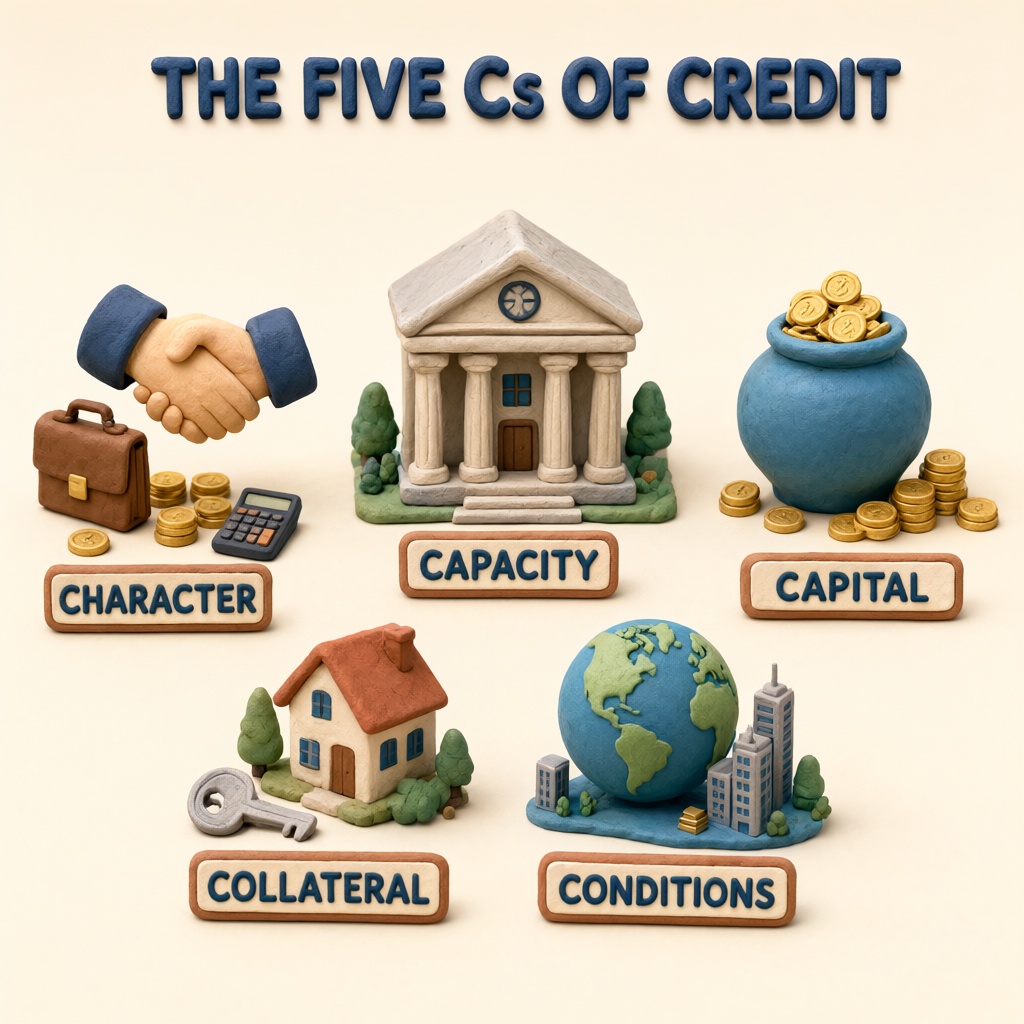
Many lenders use the traditional Five Cs of Credit as a framework for evaluating creditworthiness.
Although the exact criteria and weightings vary between institutions and loan products, the Five Cs provide a useful way to understand the underwriting process.
1. Character: Does the borrower demonstrate responsible repayment behaviour?
Character refers primarily to a borrower’s credit history and repayment behaviour.
The underwriter may examine:
- Previous loan repayment records
- Credit card payment history
- Existing and past defaults
- Late payments
- Accounts in collections
- Bankruptcy or insolvency records, where relevant
- Credit utilisation
- Length of credit history
- Number of recent credit applications
A borrower who consistently repays obligations on time may demonstrate a stronger repayment track record than someone with repeated delinquencies.
However, credit history is not the whole story.
A borrower with limited credit history may not necessarily be financially irresponsible. They may simply have never borrowed before.
Likewise, a past financial difficulty should be assessed in context. A temporary job loss, medical emergency or other unforeseen event may have affected a borrower’s repayment record.
The lender needs to distinguish between historical problems and the borrower’s current financial position.
A good credit history is evidence of past behaviour—not a guarantee of future repayment.
2. Capacity: Can the borrower afford the loan?
Capacity is one of the most important components of credit underwriting.
It evaluates the borrower’s ability to repay the loan using available income or cash flow.
The underwriter examines:
- Monthly income
- Employment stability
- Business income
- Existing loan repayments
- Household expenses
- Proposed loan instalments
- Other financial obligations
- Income consistency
- Future repayment commitments
Consider a borrower earning $5,000 per month.
Their existing monthly obligations are:
| Financial obligation | Monthly amount |
|---|---|
| Existing personal loan | $600 |
| Car loan | $450 |
| Credit card repayment | $250 |
| Proposed new loan payment | $700 |
| Total debt payments | $2,000 |
The borrower has a gross monthly income of $5,000 and debt payments totalling $2,000.
Their debt-to-income ratio would be:
[
\text{DTI}=\frac{\text{Monthly Debt Payments}}{\text{Gross Monthly Income}}\times100
]
[
\text{DTI}=\frac{2,000}{5,000}\times100=40%
]
The borrower would have a debt-to-income ratio of 40%.
Whether this is acceptable depends on the lender, the loan type, the borrower’s other expenses, income stability and applicable lending standards.
A borrower earning a high salary can still struggle financially if they have substantial existing liabilities.
The devil is in the details: income alone does not reveal the complete picture.
3. Capital: What financial resources does the borrower have?
Capital refers to the borrower’s financial resources, savings, investments or equity that may support repayment or reduce exposure to risk.
It may include:
- Savings
- Investments
- Retirement assets, where appropriate
- Business equity
- Personal net worth
- Down payment
- Other liquid assets
Capital can provide a financial cushion when a borrower faces unexpected circumstances.
For example, consider two borrowers with identical incomes and repayment obligations.
Borrower A has $500 in savings.
Borrower B has $15,000 in accessible savings.
If either borrower experiences a temporary loss of income, Borrower B may have greater financial flexibility to continue making loan payments.
Capital is particularly relevant in mortgage lending, business lending and secured credit, where the borrower may be expected to contribute equity towards the transaction.
However, assets should not automatically be treated as available repayment income. The lender must consider whether the assets are liquid, accessible and suitable for supporting repayment.
4. Collateral: What security supports the loan?
Collateral refers to assets pledged to secure a loan.
If the borrower defaults and the lender has enforceable security rights, the lender may be able to recover some of its outstanding exposure through the collateral, subject to applicable laws and procedures.
Examples include:
| Loan type | Possible collateral |
|---|---|
| Mortgage | Residential or commercial property |
| Vehicle loan | Vehicle being financed |
| Secured business loan | Machinery, property or other eligible assets |
| Secured credit facility | Deposits, investments or other assets |
The underwriter may examine:
- Market value of the asset
- Ownership
- Legal title
- Existing charges or liens
- Asset condition
- Valuation methodology
- Liquidity
- Ease of recovery
- Legal enforceability of the security
Collateral reduces potential loss in certain circumstances, but it does not eliminate credit risk.
A bank cannot assume that a property will always sell at the expected valuation or that recovering collateral will be immediate, inexpensive or straightforward.
A loan should not be approved solely because the borrower owns a valuable asset. The primary repayment source must still be evaluated.
5. Conditions: What is the purpose of the loan, and what external factors affect repayment?
Conditions refer to the circumstances surrounding the loan.
These may include:
- Purpose of borrowing
- Loan amount
- Loan tenure
- Interest rate
- Industry or economic conditions
- Employment sector
- Business performance
- Regulatory requirements
- Loan-specific terms and conditions
For example, a business operating in a stable industry may face a different risk profile from one operating in a highly cyclical industry.
Similarly, a borrower seeking a loan for a productive business expansion may present a different risk profile from someone borrowing to cover recurring financial shortfalls.
The underwriter must understand why the borrower needs the money and whether the proposed financing makes financial sense.
The Five Cs should not be treated as five isolated boxes. They work together to create an overall picture of creditworthiness.
How Banks Assess a Loan Application: Step by Step
Credit underwriting typically follows a structured process. The exact workflow varies depending on the lender, product, country, loan size and complexity.
Step 1: Loan Application and Initial Screening
The process begins when a borrower submits a loan application.
The application typically contains information about:
- Applicant identity
- Contact details
- Employment or business
- Income
- Loan amount requested
- Loan purpose
- Existing liabilities
- Assets
- Other relevant information
The lender performs preliminary checks to determine whether the application meets basic eligibility criteria.
For example, a lender may have minimum income requirements, maximum loan limits, employment criteria or restrictions on certain loan purposes.
An application that does not meet basic requirements may be rejected at the initial stage, while eligible applications proceed to further assessment.
Step 2: Identity Verification and KYC
The lender must establish that the applicant is who they claim to be.
Depending on the jurisdiction and institution, this may involve:
- Government-issued identification
- Proof of address
- Tax identification details
- Verification of employment or business
- Know Your Customer (KYC) checks
- Fraud screening
- Sanctions or other regulatory checks where applicable
Identity verification is important because lending institutions must manage fraud, financial crime and regulatory risks.
An applicant may appear financially eligible but still require additional verification before the lender can proceed.
Step 3: Document Collection and Verification
The underwriter reviews documents supporting the information provided in the application.
For salaried borrowers, documents may include:
- Payslips
- Employment letters
- Bank statements
- Tax returns
- Credit reports
- Existing loan statements
- Proof of assets
For self-employed borrowers or businesses, documents may include:
- Financial statements
- Tax filings
- Business bank statements
- Business registration documents
- Cash flow statements
- Accounts receivable and payable details
- Details of existing borrowing
- Ownership information
Document verification is a critical part of underwriting.
A borrower may report a particular income, but the lender must determine whether that income is genuine, consistent, sustainable and adequately supported.
A bank statement may show regular credits, but those credits should not automatically be treated as salary or business income without understanding their source.
Likewise, a financial statement may show profitability, but the lender may need to examine whether the business actually generates sufficient cash to repay its debt.
In banking, documentation is not merely administrative paperwork. It forms part of the evidence supporting the credit decision.
Step 4: Credit Bureau and Credit History Review
The lender may obtain a credit report from an authorised credit bureau, subject to applicable consent and regulatory requirements.
The report may contain information relating to:
- Credit accounts
- Outstanding balances
- Repayment history
- Delinquencies
- Defaults
- Credit inquiries
- Credit utilisation
- Account age
- Public records, where permitted
Credit scores can help lenders evaluate borrowers efficiently, especially when dealing with large volumes of applications.
However, a credit score is generally a predictive indicator rather than a complete lending decision.
The underwriter may need to investigate the underlying credit information, particularly when the application contains unusual circumstances.
For example, an applicant may have a relatively good score but significant recent borrowing. Another applicant may have a lower score because of limited credit history rather than repeated repayment failures.
The context matters.
Step 5: Income and Repayment Capacity Assessment
The lender evaluates whether the borrower can meet the proposed loan repayment comfortably.
This may involve calculating or examining:
- Debt-to-income ratio
- Debt service coverage ratio
- Fixed obligation-to-income ratio
- Disposable income
- Cash flow
- Income stability
- Repayment schedules
The appropriate calculation depends on the loan product and lender’s policy.
For personal loans and mortgages, lenders often focus on household income and existing debt obligations.
For commercial loans, cash flow generated by the business is often central to the analysis.
A business may have substantial revenue but still be unable to repay debt if its expenses, working capital requirements and existing obligations consume most of its cash flow.
Step 6: Collateral Valuation and Legal Assessment
Where the loan is secured, the lender evaluates the collateral.
For a property loan, this may involve:
- Property valuation
- Ownership verification
- Title examination
- Legal due diligence
- Assessment of existing encumbrances
- Loan-to-value calculation
- Review of insurance requirements
For other assets, the lender may assess their value, ownership, condition, marketability and legal enforceability of the security.
Collateral assessment is particularly important because the value of an asset may change over time.
A property that appears sufficient to secure a loan today may be worth less if market conditions deteriorate.
Step 7: Risk Assessment and Credit Recommendation
Once the information has been collected and analysed, the underwriter evaluates the overall risk.
The assessment may consider:
- Credit history
- Income stability
- Repayment capacity
- Existing debt
- Loan purpose
- Collateral
- Financial ratios
- Industry conditions
- Loan structure
- Potential weaknesses
- Compliance with credit policy
The underwriter may recommend:
- Approval
- Approval subject to conditions
- Reduced loan amount
- Additional collateral
- Additional documentation
- Higher pricing, where permitted and appropriate
- Rejection
The recommendation should be supported by an objective analysis of the available information.
Step 8: Credit Approval
The application is submitted to the appropriate approval authority.
Depending on the institution and exposure, approval may be granted by:
- An authorised credit officer
- A branch-level sanctioning authority
- A credit manager
- A credit committee
- Senior management
- A centralised credit team
Larger or more complex exposures may require higher approval authority.
The approval process is designed to ensure that lending decisions are consistent with the institution’s credit policy and risk appetite.
Step 9: Documentation, Conditions and Disbursement
Approval does not always mean that the money is immediately disbursed.
The borrower may need to complete additional requirements, such as:
- Signing the loan agreement
- Executing security documents
- Providing insurance
- Completing legal formalities
- Meeting pre-disbursement conditions
- Providing additional documents
- Establishing required accounts
Once the conditions are fulfilled and the documentation is complete, the lender may disburse the loan.
Step 10: Post-Disbursement Monitoring
Underwriting does not end when the loan is approved.
Lenders monitor the loan throughout its lifecycle to identify potential repayment problems.
Depending on the loan type, monitoring may include:
- Repayment performance
- Delinquencies
- Financial statements
- Business performance
- Changes in credit rating
- Collateral values
- Compliance with covenants
- Changes in borrower circumstances
Early identification of risk can help lenders take corrective action before a loan deteriorates significantly.
Credit Underwriting for Different Types of Loans

Underwriting is not a one-size-fits-all process.
The information and risk factors considered depend heavily on the type of loan.
1. Personal Loans
Personal loans are often unsecured, meaning the lender does not require specific collateral.
The underwriter may focus on:
- Income
- Employment stability
- Credit score
- Credit history
- Existing debt
- Monthly repayment capacity
- Loan purpose, where relevant
Because the lender may not have specific collateral to recover in case of default, repayment capacity and credit history can be particularly important.
2. Home Loans and Mortgages
How to Prepare Financially Before Buying Your First Home: A Smart Banker’s Guide : CLICK HERE!
Mortgage underwriting involves evaluating both the borrower and the property.
The borrower assessment may include:
- Income
- Employment
- Existing liabilities
- Credit history
- Repayment capacity
- Down payment
The property assessment may include:
- Market valuation
- Legal title
- Ownership
- Property condition
- Location
- Loan-to-value ratio
- Insurance and other requirements
A borrower may have a strong income but still face difficulty obtaining a mortgage if the property does not meet the lender’s requirements.
Likewise, a valuable property does not automatically compensate for inadequate repayment capacity.
3. Business and Commercial Loans
Commercial underwriting can be more complex because repayment depends on the financial performance of the business and the purpose of borrowing.
The underwriter may examine:
- Business revenue
- Operating expenses
- Profitability
- Cash flow
- Working capital
- Existing debt
- Business assets
- Industry conditions
- Management experience
- Business model
- Customer concentration
- Supplier concentration
- Project feasibility
- Repayment source
For example, a business seeking a loan to purchase machinery may be assessed on whether the investment is expected to generate sufficient additional cash flow to service the loan.
A profitable business is not automatically a creditworthy borrower. Cash flow timing, existing obligations and future business risks all matter.
4. Credit Cards
Credit card underwriting evaluates whether an applicant is likely to manage revolving credit responsibly.
Factors may include:
- Income
- Credit history
- Existing debt
- Credit score
- Credit utilisation
- Previous payment behaviour
- Requested credit limit
The lender must assess not only whether the applicant can repay the current balance but also how the credit facility may be used over time.
5. Digital Loans and Buy Now, Pay Later (BNPL)
Digital lending platforms may use automated underwriting models to evaluate applications quickly.
Depending on the product and jurisdiction, assessment may involve:
- Traditional credit bureau data
- Bank account information
- Income verification
- Transaction data
- Employment information
- Digital application information
- Alternative data, where legally permitted
- Automated fraud detection
These models can improve speed and accessibility, particularly for applicants with limited traditional credit history.
However, the use of alternative data and automated decisions raises important questions about data quality, privacy, fairness, explainability and model accuracy.
Important Financial Ratios Used in Credit Underwriting
Financial ratios help lenders convert financial information into measurable indicators of repayment capacity and risk.
The ratios used depend on the borrower and the loan type.
1. Debt-to-Income Ratio (DTI)
DTI measures the borrower’s monthly debt obligations relative to income.
[
DTI=\frac{\text{Monthly Debt Payments}}{\text{Gross Monthly Income}}\times100
]
Example:
Monthly gross income: $6,000
Monthly debt payments: $1,800
[
DTI=\frac{1,800}{6,000}\times100=30%
]
The borrower has a DTI of 30%.
A lower DTI generally indicates that a smaller proportion of income is committed to debt repayments, but acceptable thresholds vary across lenders and products.
2. Loan-to-Value Ratio (LTV)
LTV compares the loan amount with the value of the asset securing the loan.
[
LTV=\frac{\text{Loan Amount}}{\text{Collateral Value}}\times100
]
Example:
Property value: $300,000
Loan amount: $240,000
[
LTV=\frac{240,000}{300,000}\times100=80%
]
The loan-to-value ratio is 80%.
A lower LTV means the borrower has more equity in the property relative to the loan.
This may reduce the lender’s exposure if it must recover the loan through collateral.
3. Debt Service Coverage Ratio (DSCR)
DSCR is particularly useful in business and commercial lending.
It compares the cash flow available for debt servicing with the borrower’s debt obligations.
[
DSCR=\frac{\text{Cash Flow Available for Debt Service}}{\text{Total Debt Service}}
]
Example:
Annual cash flow available for debt service: $120,000
Annual principal and interest payments: $100,000
[
DSCR=\frac{120,000}{100,000}=1.20
]
The business has a DSCR of 1.20.
This means it generates $1.20 of cash flow for every $1.00 of debt service.
A DSCR below 1.00 indicates that the measured cash flow is insufficient to cover the debt service under the calculation used.
However, lenders may define cash flow differently, and the acceptable ratio depends on the loan, industry, borrower and institution.
4. Debt-to-Equity Ratio
This ratio compares a company’s debt with its equity.
[
\text{Debt-to-Equity Ratio}=\frac{\text{Total Debt}}{\text{Shareholders’ Equity}}
]
A higher ratio may indicate greater reliance on borrowed funds and potentially higher financial risk.
It should be interpreted alongside industry norms, cash flow, profitability and the structure of the business.
5. Net Worth
Net worth represents the difference between assets and liabilities.
[
\text{Net Worth}=\text{Total Assets}-\text{Total Liabilities}
]
A borrower with positive net worth may have financial resources beyond their regular income.
However, not all assets are equally useful for repayment. A house, business investment or retirement asset may not be immediately accessible without selling, borrowing against it or incurring costs.
What Makes a Loan Application Strong?
A strong application is not necessarily one with the highest salary or the largest asset base.
It is one where the borrower demonstrates a reasonable ability to repay, supported by reliable information.
A strong loan application typically has:
Stable and verifiable income: The income is genuine, reasonably predictable and supported by documentation.
Manageable existing debt: The borrower has sufficient room in their budget or cash flow to accommodate the new repayment.
Consistent repayment history: Previous borrowing demonstrates responsible payment behaviour, although past difficulties may be evaluated in context.
Clear loan purpose: The reason for borrowing is understandable and appropriate for the product.
Complete documentation: The lender can verify the information required to make a decision.
Reasonable loan amount: The amount requested is proportionate to the borrower’s income, cash flow, assets or financing need.
Adequate collateral, where required: The security is legally acceptable and appropriately valued.
Financial resilience: The borrower has some ability to withstand unexpected expenses, changes in income or adverse conditions.
Why Banks Reject Loan Applications
A loan rejection does not always mean the applicant is financially irresponsible.
It may mean that the application does not meet the lender’s requirements or that the lender considers the risk too high.
Common reasons include:
1. Insufficient income
The applicant may not earn enough to support the proposed loan repayment.
2. High existing debt
The applicant may already have significant monthly obligations, leaving insufficient repayment capacity.
3. Poor credit history
Repeated late payments, defaults, collections or other negative credit information may affect the decision.
4. Unstable income
Income that is irregular, difficult to verify or highly dependent on uncertain business activity may create repayment concerns.
5. Incomplete documentation
Missing, inconsistent or unverifiable information can prevent the lender from completing the assessment.
6. Unacceptable collateral
The asset may have insufficient value, legal complications, ownership issues or other problems.
7. Loan amount is too high
The requested amount may exceed the borrower’s repayment capacity or the lender’s permitted limits.
8. The application does not meet the lender’s policy
Lenders have different risk appetites. A borrower rejected by one institution may qualify with another, depending on the product and circumstances.
9. Fraud or verification concerns
Information that cannot be verified or inconsistencies between documents may lead to additional investigation or rejection.
10. Industry or economic risk
In commercial lending, adverse industry conditions or business-specific risks may influence the decision even if the borrower has historically performed well.
A rejection is not necessarily the end of the road. Understanding the reason can help an applicant address the underlying issue before applying again.
What Can Borrowers Do Before Applying for a Loan?
Borrowers can improve their preparedness by taking a few practical steps before submitting an application.
Review your credit report
Check for errors, outdated information or accounts that you do not recognise. If errors exist, follow the appropriate dispute process.
Calculate your existing debt obligations
Understand how much of your monthly income is already committed to repayments.
Avoid unnecessary borrowing
Multiple new credit applications or additional borrowing may affect your financial position and credit assessment.
Prepare your documents
Gather income records, bank statements, tax documents, identification and any other information required by the lender.
Choose a realistic loan amount
Borrow only what you need and what you can reasonably repay.
Understand the loan terms
Review the interest rate, repayment period, fees, penalties and other contractual obligations.
Strengthen your financial cushion
Savings can help you manage unexpected expenses without immediately falling behind on repayments.
The Role of Technology in Modern Credit Underwriting
Credit underwriting is changing rapidly as banks, fintech companies and digital lenders adopt technology.
Traditional underwriting involved substantial manual review of documents, calculations, verification and approvals.
Today, many lenders use technology to automate parts of the process.
Automated credit scoring
Models analyse borrower information and assign scores or risk classifications based on statistical relationships and historical repayment data.
This can help lenders process applications more efficiently and apply consistent criteria.
Artificial intelligence and machine learning
Machine learning models may analyse large volumes of data to identify patterns associated with repayment risk.
These models can potentially improve prediction, but their performance depends on the quality and representativeness of the data.
Poor data or biased historical patterns may lead to unfair or inaccurate outcomes.
Bank statement analysis
Digital tools can extract and categorise transaction data to help lenders assess income, expenses and cash flow.
For self-employed borrowers or people with limited traditional documentation, this may provide additional insight into financial behaviour.
Digital document verification
Technology can help verify identity, extract information from documents, identify inconsistencies and flag potential fraud.
Loan Origination Systems (LOS)
Loan origination systems help manage the lending process from application through assessment, approval, documentation and disbursement.
They can integrate multiple workflows, support document management, assign applications, record decisions and track outstanding requirements.
A well-designed LOS can reduce manual work and improve turnaround time.
However, automation does not eliminate the need for sound credit judgement, governance, human oversight and clear accountability.
The objective is not merely to approve loans faster. It is to make lending decisions that are efficient, fair, consistent and financially sound.
Credit Underwriting vs. Credit Scoring
These terms are related, but they are not identical.
| Credit scoring | Credit underwriting |
|---|---|
| Evaluates borrower information using a scoring model | Evaluates the overall credit application |
| Often produces a numerical score or risk classification | Produces a lending recommendation or decision |
| May focus on selected predictive variables | Considers broader financial, documentary and transaction factors |
| Can be automated | Can be automated, manual or hybrid |
| Supports decision-making | Includes decision-making and associated conditions |
Credit scoring can be an important component of underwriting.
But a credit score alone may not capture the full complexity of a borrower’s financial situation.
For example, a commercial borrower may require detailed analysis of cash flow, financial statements, collateral, industry conditions and the purpose of financing—factors that cannot be adequately represented by a single consumer credit score.
Credit Underwriting vs. Credit Risk Management
Credit underwriting primarily focuses on evaluating and making decisions about individual loan applications or transactions.
Credit risk management is broader.
It includes the policies, processes, systems and controls used to identify, measure, monitor and manage credit risk across the institution.
Credit risk management may include:
- Credit policies
- Risk appetite
- Credit approval authorities
- Portfolio monitoring
- Risk rating systems
- Concentration limits
- Early warning systems
- Problem loan management
- Credit reviews
- Loan loss provisioning
- Risk reporting
Underwriting is therefore one of the important components of a bank’s overall credit risk management framework.
A bank may approve an individual loan that appears acceptable, but it must also consider the cumulative risk of its entire loan portfolio.
For example, lending heavily to a single industry may expose the bank to significant losses if that industry experiences a downturn.
Good underwriting at the individual loan level and good portfolio risk management at the institutional level work together.
A Practical Perspective: Why Credit Assessment Requires More Than a Checklist
In credit-related banking work, documents provide the foundation for assessment—but they do not always tell the entire story.
An application may contain all the required documents and still require further scrutiny.
Income may be inconsistent with the bank statement. Existing liabilities may not be fully disclosed. A business may report strong revenue but weak cash flow. A collateral valuation may not reflect the risks associated with the asset.
This is why credit assessment requires attention to detail, financial understanding and the ability to identify inconsistencies.
A checklist helps ensure that important requirements are not overlooked. But sound underwriting also requires the ability to interpret the information, understand the borrower’s circumstances and recognise potential risks.
In credit, the devil is often in the details.
A seemingly small discrepancy can raise an important question. Resolving that question before disbursement may prevent a much larger problem later.
The quality of underwriting is not measured by how many applications are approved or rejected. It is measured by the quality, consistency and prudence of the decisions made.
Frequently Asked Questions
What is credit underwriting in simple terms?
Credit underwriting is the process a lender uses to evaluate whether a borrower is likely to repay a loan. It involves assessing income, debt, credit history, financial stability, loan purpose, collateral and other relevant risks.
Who is a credit underwriter?
A credit underwriter is a professional who evaluates loan applications and assesses the risk associated with lending to an individual or business. Depending on the institution, underwriters may recommend approvals, rejections or approvals subject to conditions.
What are the Five Cs of Credit?
The Five Cs are Character, Capacity, Capital, Collateral and Conditions. They provide a framework for assessing a borrower’s creditworthiness.
Does a high credit score guarantee loan approval?
No. A high credit score may strengthen an application, but lenders also consider income, existing debt, repayment capacity, loan purpose, collateral and their own eligibility requirements.
Can a loan be approved with a low credit score?
Possibly. Different lenders have different criteria. Some may consider other aspects of the borrower’s financial situation, while others may have minimum credit score requirements.
Why is income important in credit underwriting?
Income is an important repayment source for many borrowers. Lenders evaluate its amount, stability, reliability and whether it is sufficient to support existing and proposed obligations.
What is the difference between secured and unsecured lending?
Secured lending involves collateral supporting the loan. Unsecured lending generally does not require specific collateral. Unsecured lenders may rely more heavily on credit history, income and repayment capacity.
What is a Loan Origination System?
A Loan Origination System (LOS) is a technology platform used to manage the lending process. It may support applications, document collection, verification, underwriting workflows, approvals, compliance checks and disbursement.
Does credit underwriting happen only before loan approval?
No. Initial underwriting occurs before approval, but lenders also monitor borrowers and loan portfolios after disbursement. Ongoing monitoring helps identify changes in repayment risk.
Conclusion
Credit underwriting is one of the most important processes in lending because it determines how financial institutions evaluate risk before extending credit.
A sound credit decision requires more than checking an applicant’s salary or credit score. It involves understanding the borrower’s financial position, repayment capacity, credit history, loan purpose, collateral and the circumstances that may affect future repayment.
The process has become increasingly technology-driven, with automated scoring, digital verification, data analytics and loan origination systems improving efficiency.
Yet the fundamentals remain the same: reliable information, careful analysis, sound judgement and responsible lending.
For borrowers, understanding underwriting can make the loan application process less intimidating and help them prepare more effectively.
For lenders, it remains a critical safeguard against avoidable losses.
Ultimately, good lending is not simply about giving money to those who ask for it. It is about making informed decisions that balance opportunity with risk.
Disclaimer: This article is intended for educational purposes only. Credit underwriting practices, eligibility criteria and regulatory requirements vary by lender, loan type and jurisdiction. The examples and calculations are illustrative and should not be interpreted as lending advice or guarantees of approval.








Leave a Reply