



How to Build an Emergency Fund: A Step-by-Step Financial Guide
Imagine Your Next Unexpected Expense
Your car breaks down on the way to work. Your refrigerator suddenly stops functioning. You receive an unexpected medical bill. Or, perhaps, your employer announces layoffs, and your regular paycheck is no longer guaranteed.
None of these expenses necessarily arrives at a convenient time. Yet the financial consequences can be very different depending on whether you have money set aside.
Without savings, an unexpected expense may mean borrowing from a credit card, taking out a loan, postponing another bill, or asking someone for financial help. With an emergency fund, you have another option: use the money you deliberately saved for situations like this.
An emergency fund doesn’t prevent life’s unexpected events. It gives you a financial cushion when they happen.
And the good news? You don’t need to save thousands of dollars immediately to begin. You can build your emergency fund gradually, starting with whatever amount you can realistically afford.

What Is an Emergency Fund?
An emergency fund is money set aside specifically for unexpected expenses or financial emergencies.
Unlike savings for a vacation, a new phone, a home purchase, or a planned celebration, emergency savings are reserved for situations that could disrupt your financial stability.
Common examples include:
- Unexpected medical expenses
- Job loss or a temporary loss of income
- Urgent home repairs
- Essential car repairs
- Emergency travel for family reasons
- Unexpected expenses necessary to continue working
The purpose is simple: to help you handle financial shocks without derailing your everyday finances or relying heavily on borrowing.
The Consumer Financial Protection Bureau (CFPB) describes emergency savings as an important way to recover more quickly from unexpected financial shocks. Even a small amount saved can provide some protection.
Read the CFPB’s guide to emergency funds.
How Much Should You Have in an Emergency Fund?
Emergency Fund Calculator
Find out how much you need to save for emergencies and how long it may take to reach your goal.
Your Emergency Fund Plan
This calculator provides an illustrative savings target. It excludes interest, inflation, withdrawals and changes in expenses. Your appropriate emergency fund depends on your individual financial circumstances.
A common recommendation is to save three to six months of essential living expenses.
However, this is a guideline—not a universal requirement.
The right amount depends on factors such as your income stability, employment situation, household responsibilities, insurance coverage, health needs, and access to other financial resources.
The three-month emergency fund
Saving three months of essential expenses may be a reasonable initial target for someone with:
- Relatively stable employment
- Low financial obligations
- Few dependents
- Another household income
- A reasonably predictable financial situation
The six-month emergency fund
A larger reserve may be appropriate if you:
- Support children, parents, or other dependants
- Have a single household income
- Work in an industry with uncertain employment
- Have irregular income
- Are self-employed or freelance
- Have significant recurring obligations
- Would find it difficult to replace your income quickly
People with highly variable income or additional financial responsibilities may prefer an even larger cushion.
The Federal Reserve’s research on household financial well-being highlights the importance of having savings to cover several months of expenses in the event of income loss.
The important thing is not to compare your emergency fund with someone else’s. Your target should reflect your own financial circumstances.
The 50/30/20 Budgeting Rule: A Practical Guide to Managing Your Money
How to Calculate Your Emergency Fund
Instead of calculating your emergency fund using your salary, calculate it using your essential monthly expenses.
During an emergency, you may be able to reduce discretionary spending. You might pause dining out, shopping, subscriptions, holidays, and entertainment.
But you will still need to pay for housing, food, utilities, transport, insurance, and other necessary expenses.
Step 1: Calculate your essential monthly expenses.
Consider the expenses you would need to continue paying if your income suddenly stopped.
| Essential expense | Monthly amount |
|---|---|
| Rent or mortgage | $1,200 |
| Groceries | $450 |
| Utilities | $150 |
| Transportation | $200 |
| Insurance | $150 |
| Essential healthcare | $100 |
| Minimum debt payments | $150 |
| Other essentials | $100 |
| Total essential expenses | $2,500 |
These figures are illustrative. Your actual expenses may be significantly higher or lower.
Step 2: Multiply your monthly expenses by your target number of months.
If your essential monthly expenses are $2,500:
| Target | Emergency fund |
|---|---|
| 1 month | $2,500 |
| 3 months | $7,500 |
| 6 months | $15,000 |
| 9 months | $22,500 |
For this household, a six-month emergency fund would be $15,000.
This may look like a substantial amount. But remember: you don’t need to reach the final target before you have any protection.
Your first goal could be $500. Your next could be $1,000. Then one month’s essential expenses.
Each milestone makes your financial position a little stronger.
How to Build an Emergency Fund Step by Step
Step 1: Set a small, achievable starting goal.
If you are starting from zero, don’t make six months of expenses your immediate target.
A large number can make saving feel impossible, particularly when you are managing bills, debt, and everyday expenses.
Instead, establish a starter emergency fund.
For example:
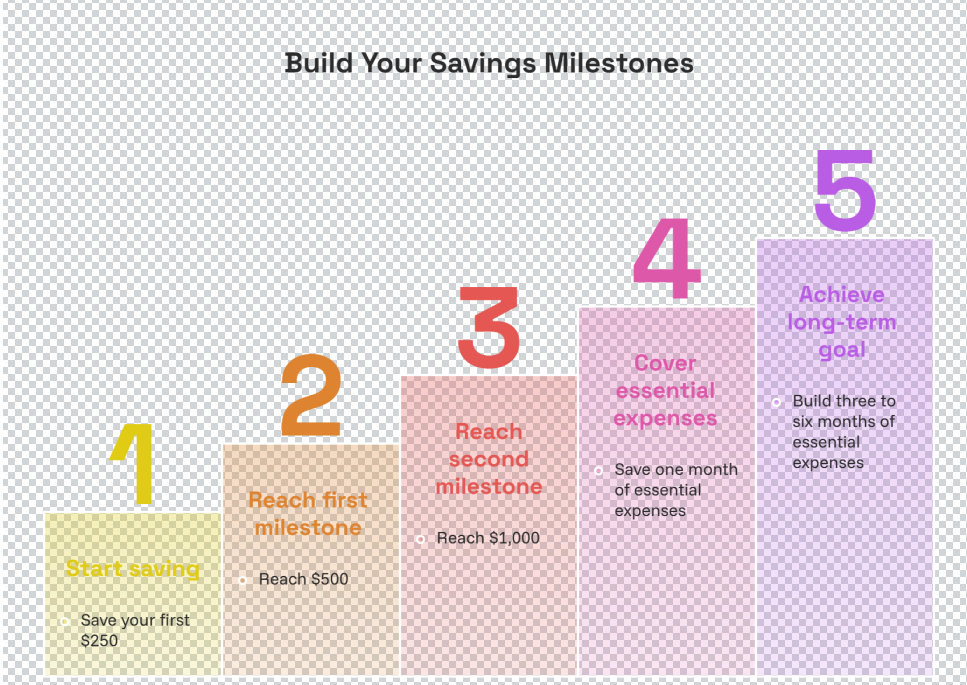
- First target: $250
- Second target: $500
- Third target: $1,000
- Fourth target: One month of essential expenses
- Long-term target: Three to six months of essential expenses
These are example milestones, not fixed rules. Choose amounts that make sense for your financial circumstances.
The first $500 you save may not cover a job loss, but it could help you handle a minor repair, unexpected bill, or urgent purchase without immediately reaching for a credit card.
Small savings are not insignificant savings. They are the beginning of financial resilience.
Step 2: Find out where your money goes.
Before deciding how much to save, understand your current spending.
Review your bank statements, bills, card transactions, and cash spending for the past month or two.
Divide your expenses into three groups:
Essential expenses
- Housing
- Groceries
- Utilities
- Transportation
- Insurance
- Healthcare
- Minimum debt repayments
Discretionary expenses
- Restaurant meals
- Shopping
- Entertainment
- Subscriptions
- Non-essential travel
Irregular expenses
- Annual insurance premiums
- School-related costs
- Vehicle maintenance
- Seasonal bills
- Planned gifts
- Annual memberships
This distinction matters because not every expense that arrives unexpectedly is a genuine emergency.
For example, car maintenance, annual insurance, and holiday spending may be irregular, but they are often predictable. These expenses deserve their own sinking funds rather than being repeatedly taken from your emergency fund.
Step 3: Decide how much you can save each month.
You don’t need to follow a rigid savings percentage.
Your contribution should be sustainable enough that you can continue making it consistently.
For example, if you can save $100 per month:
| Saving per month | Total after 6 months | Total after 12 months |
|---|---|---|
| $25 | $150 | $300 |
| $50 | $300 | $600 |
| $100 | $600 | $1,200 |
| $200 | $1,200 | $2,400 |
| $300 | $1,800 | $3,600 |
These figures exclude interest.
Even $25 a month gives you $300 after a year. It may not be a complete safety net, but it is money you didn’t have before.
If your income changes, change your savings contribution accordingly. A savings plan should support your finances, not make them more difficult.
Step 4: Automate your savings
One of the simplest ways to build a savings habit is to transfer money into your emergency fund automatically.
You could arrange a transfer:
- On payday
- Weekly
- Monthly
- After receiving a freelance payment
- Whenever your account balance exceeds a predetermined amount
For example, if you receive $3,000 monthly, you could automatically transfer $100 into your emergency savings when your salary arrives.
This means you don’t have to remember to save at the end of the month.
The CFPB recommends creating a consistent savings system, including recurring automatic transfers where appropriate.
However, make sure you have enough money in your spending account to cover scheduled payments. Automation should make saving easier—not create overdraft fees.
Step 5: Use extra income to accelerate your savings.
Regular contributions build the habit. Additional income can help you reach your goal faster.
Consider directing a portion of:
- Bonuses
- Tax refunds
- Freelance income
- Cash gifts
- Selling unused belongings
- Overtime earnings
- Temporary side-income earnings
You don’t have to put every extra dollar into savings.
A balanced approach could be to save 50% of additional income and use the remainder for other priorities.
For example, receiving a $600 bonus and saving $300 would immediately move your emergency fund forward without requiring a change to your regular monthly budget.
Step 6: Review your progress every month.
Your emergency fund is a financial goal that evolves as your circumstances change.
Review it monthly or quarterly.
Ask yourself:
- How much have I saved?
- Did I manage to make my planned contributions?
- Have my essential expenses increased?
- Has my employment or income stability changed?
- Have I taken money out for an emergency?
- Should I adjust my target?
If your monthly expenses increase, your emergency fund target may need to increase too.
If you change jobs, become self-employed, move to a new home, or begin supporting another family member, revisit the amount you need.
Where Should You Keep Your Emergency Fund?
An emergency fund needs to be accessible when you need it. But accessibility doesn’t necessarily mean keeping all the money in your everyday spending account.
Consider the following options.
1. A dedicated savings account
A separate savings account can help you distinguish emergency savings from money available for everyday spending.
Look for an account that offers:
- Easy access to funds
- Low or no fees
- Appropriate deposit protection, where applicable
- A competitive interest rate
- Reliable withdrawal options
2. A high-yield savings account
Where available and appropriate, a high-yield savings account may allow your emergency savings to earn interest while remaining relatively accessible.
Compare interest rates, withdrawal conditions, fees, account minimums and deposit protection.
3. A small amount of cash
Keeping a modest amount of cash accessible may be useful during emergencies such as temporary power outages, payment-system disruptions or situations where electronic payments are unavailable.
However, keeping your entire emergency fund in cash at home exposes it to risks such as theft, loss and damage.
Should you invest your emergency fund?
Generally, the money you may need during an emergency should prioritise safety and accessibility over investment returns.
An emergency fund is not primarily intended to maximise growth. Its job is to be available when you need it.
Stocks, volatile investments and other assets that could lose value at the wrong time may not be appropriate for the core emergency reserve.
What Should You Use Your Emergency Fund For?
A useful test is to ask three questions:
- Is the expense unexpected?
- Is it necessary or urgent?
- Would paying for it disrupt my regular finances or require borrowing?
If the answer to these questions is yes, it may qualify as an emergency.
Appropriate uses
- Unexpected medical treatment
- Essential home repairs
- Urgent car repairs
- Temporary loss of income
- Emergency travel
- Necessary replacement of an appliance
- Essential expenses during a period of unemployment
Expenses that generally shouldn’t come from your emergency fund
- Planned holidays
- Shopping sales
- New gadgets
- Regular annual insurance payments
- Planned vehicle servicing
- Birthday celebrations
- Routine home maintenance that can be budgeted for
The distinction is important.
If you repeatedly use your emergency fund for planned expenses, you may find that it is unavailable when a genuine emergency occurs.
What If You Have Debt and No Emergency Savings?
This is one of the most common financial dilemmas.
Should you save first or pay off debt first?
The answer often depends on the type of debt, its interest rate, your financial stability and whether you have any savings at all.
If you have no emergency savings, building a small starter fund while making required minimum debt payments may help prevent an unexpected expense from pushing you further into debt.
Once you have a basic financial cushion, you may choose to focus more aggressively on high-interest debt while continuing smaller savings contributions.
For example:
- Build a starter emergency fund.
- Continue paying the minimum required on all debts.
- Prioritise high-interest debt repayment.
- Continue making smaller emergency fund contributions.
- Increase savings once expensive debt is reduced.
This approach may help balance two important goals: reducing costly debt and avoiding the need to borrow again when an unexpected bill arrives.
Your strategy should reflect your actual debt costs and circumstances.
What If You Can’t Save Much?
Perhaps your essential expenses already consume most of your income. Perhaps you are supporting a family, dealing with rising rent or managing an uncertain income.
In such situations, the advice to save three to six months of expenses may feel disconnected from reality.
Start with what is possible.
Saving $10, $20 or $50 regularly is still a positive step if it doesn’t compromise essential bills or force you to borrow elsewhere.
You can also explore ways to improve your cash flow:
- Review recurring subscriptions and unused services.
- Negotiate bills where possible.
- Review insurance costs without compromising necessary coverage.
- Plan grocery shopping to reduce waste.
- Look for opportunities to increase income.
- Save part of occasional additional income.
- Check whether you are eligible for assistance or benefits.
An emergency fund is not built exclusively through spending cuts. For some households, increasing income is the more important part of the solution.
Don’t judge your financial progress by the amount someone else has saved. Your starting point matters.
What Real People Ask About How to Build Emergency Funds
Online financial communities regularly discuss how much an emergency fund should contain—and whether the standard three-to-six-month recommendation is realistic.
In a discussion on r/personalfinance about when an emergency fund is enough, users discuss measuring their reserves in months of expenses rather than arbitrary dollar amounts. They also debate whether to calculate the fund using essential expenses or their normal spending.
The practical takeaway is that an emergency fund should be based on what you would actually need to spend during a financial disruption.
Another recurring concern is whether people should save three months or six months. Discussions such as this Reddit thread about building a six-month emergency fund highlight considerations such as job loss, medical costs, insurance and the balance between holding cash and investing.
These discussions are useful for understanding real concerns, but individual experiences aren’t universal financial rules.
Frequently Asked Questions
Is $1,000 enough for an emergency fund?
A $1,000 emergency fund can be a useful starting point, especially if you currently have no savings. However, whether it is sufficient depends on your living expenses, financial responsibilities and the types of emergencies you might face.
For many households, it is a first milestone rather than the final goal.
Should an emergency fund cover three or six months?
Three months may be sufficient for some people with stable income, low expenses and fewer responsibilities. Six months or more may provide additional protection for people with dependants, variable income, higher obligations or uncertain employment.
There is no single amount suitable for everyone.
Should I save an emergency fund before investing?
Building at least a basic emergency reserve before committing substantial amounts to investments is often a sensible approach.
Without accessible savings, an unexpected expense may force you to sell investments at an inconvenient time or borrow money.
The amount you should build before investing depends on your circumstances and other financial priorities.
Where is the safest place to keep an emergency fund?
A separate, accessible savings account with an appropriately protected financial institution is often a practical option. The specific account should be selected based on your country, deposit protection rules, withdrawal conditions and fees.
Should I use my emergency fund for a vacation?
Generally, no. Vacations are planned expenses and should ideally be funded through a separate savings goal.
An emergency fund is meant to protect you from unexpected financial disruptions, not fund discretionary purchases.
What if I have to use my emergency fund?
Use it when you genuinely need it. That is precisely why you built it.
Once the emergency has passed, review your finances and gradually rebuild the amount you used.
You don’t need to feel guilty about using emergency savings for an actual emergency.
The Bottom Line
An emergency fund is one of the foundations of financial stability.
You may not be able to save three or six months of expenses immediately. You may not even be able to save a substantial amount this month.
But you can begin with a smaller goal, develop a consistent savings habit and gradually build a reserve that reflects your circumstances.
Financial security isn’t necessarily about having a large amount of money sitting in an account. It is about being better prepared to handle the unexpected without allowing one difficult event to derail everything else.
Start small. Keep going. Increase your savings when you can.
A financial safety net is built one contribution at a time.
Further Reading and Research
- Consumer Financial Protection Bureau – An Essential Guide to Building an Emergency Fund
- Federal Reserve Education – When the Unexpected Happens, Be Ready with an Emergency Fund
- TIAA – Building an Emergency Fund
- Reddit – When Is an Emergency Fund Enough?
Disclaimer: This article is for educational purposes only and does not constitute individual financial advice. Savings needs, financial products, deposit protection and tax treatment vary by country and personal circumstances.







Leave a Reply