


Loan Origination System: Workflow, Software, Architecture and Real-World Examples
Introduction: What happens between a loan application and loan approval?
Imagine a small business owner applying for a business loan to expand operations, purchase equipment and manage working capital.
The lender needs to review the business’s financial statements, examine its bank transactions, assess existing liabilities, verify supporting documents and evaluate its repayment capacity.
The application may also pass through several departments before a final lending decision is made.
When lenders handle large volumes of applications, coordinating these activities manually can become difficult. Repeated data entry, incomplete documentation, delayed verification and disconnected systems can affect the overall lending experience.
This is where a loan origination system (LOS) becomes important.
A loan origination system helps financial institutions manage the lending journey, from application submission and document collection to credit assessment, approval and disbursement.
Modern loan origination system software can also connect with credit bureaus, identity verification services, banking systems, document management platforms and automated decision engines.
For banks, NBFCs, credit unions, mortgage lenders and fintech companies, an LOS can help create a more structured and efficient lending process.

What is a loan origination system (LOS)?
A loan origination system (LOS) is a software platform that helps lenders manage and automate the activities involved in processing a loan application.
It provides a centralised environment to capture borrower information, collect documents, perform verification, support credit assessment, manage approvals and track applications.
In simple terms, a loan origination system helps a lender move a loan application through different stages until a lending decision is made and the loan is ready for disbursement.
A typical LOS may support:
- Online loan application and customer onboarding
- Document collection and verification
- Identity and KYC checks
- Credit bureau integration
- Income and bank statement analysis
- Credit assessment and underwriting workflows
- Approval and exception management
- Loan documentation and electronic signatures
- Disbursement integration
- Application tracking and reporting
The exact capabilities depend on the software, lender’s requirements, loan products and implementation.
How does a loan origination system work? The 7-step workflow
Loan Origination System Workflow: CLICK HERE!
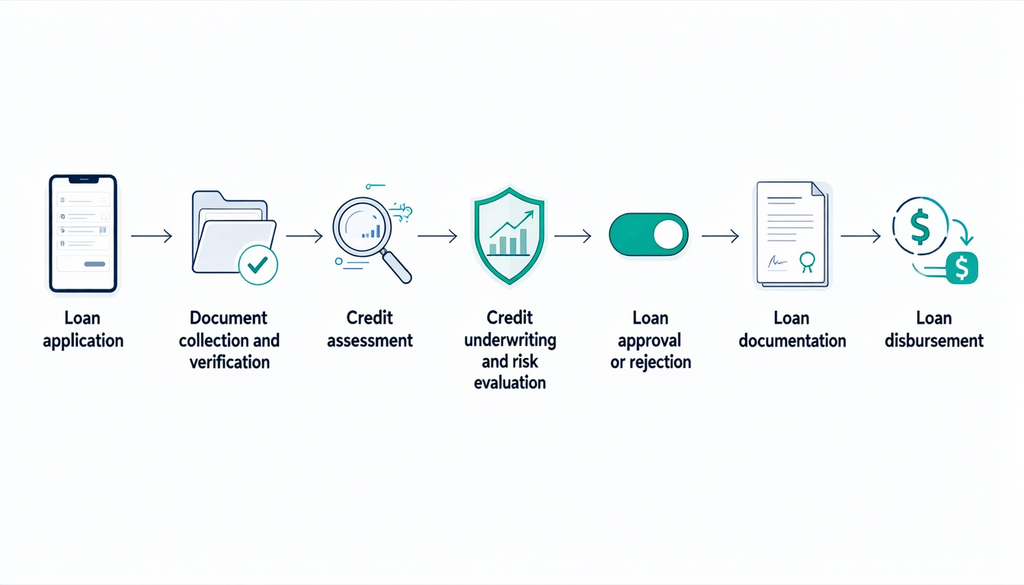
A loan origination system workflow generally follows seven major stages. The exact sequence can vary depending on whether the lender processes home loans, personal loans, commercial loans, mortgages or small-business loans.
1. Loan application and customer onboarding
The process begins when a borrower applies for a loan.
The application may be submitted through a bank branch, website, mobile application, lending partner or fintech platform.
The system captures relevant information, including:
- Applicant’s name and contact details
- Employment or business information
- Loan amount and purpose
- Income details
- Existing financial obligations
- Loan product and repayment preferences
A digital loan origination system can allow customers to submit applications online and track their progress.
Example: A small business owner applying for equipment financing submits business details, annual turnover, bank statements and the requested loan amount through a digital lending platform. The LOS creates an application record and initiates the next steps in the lending workflow.
2. Document collection and verification
After the application is submitted, the lender collects the documents required to assess the borrower.
Depending on the loan product, these may include:
- Identity and address proof
- Salary slips or income statements
- Bank statements
- Tax returns
- Business financial statements
- Property-related documents
- Existing loan details
The LOS can organise documents, identify missing information and route applications for verification.
Some systems also integrate with document processing tools that use optical character recognition (OCR) to extract information from uploaded documents.
However, automated extraction does not eliminate the need for validation. Incorrect or incomplete information may still require manual review.
3. Credit assessment and eligibility checks
The lender evaluates whether the applicant meets the eligibility criteria for the loan.
The assessment may consider:
- Monthly income and expenses
- Existing loan obligations
- Credit history
- Repayment behaviour
- Debt-to-income ratio
- Loan-to-value ratio, where applicable
- Employment or business stability
- Internal lending policies
The LOS may connect with external services such as credit bureaus, bank account data providers and verification platforms.
Example: A business may report strong annual revenue, but its bank statements could reveal irregular cash flows and substantial existing loan repayments. The lender needs to consider these factors before determining the applicant’s repayment capacity.
4. Credit underwriting and risk evaluation
Credit underwriting is one of the most important stages of the loan origination process.
At this stage, the lender evaluates the borrower’s ability and willingness to repay the loan.
The underwriting process may involve:
- Reviewing the applicant’s financial profile
- Assessing repayment capacity
- Analysing credit history
- Evaluating collateral, where applicable
- Identifying potential risks
- Applying internal credit policies
- Reviewing exceptions and additional conditions
Some loan origination system software includes configurable rules engines and automated decisioning capabilities.
These tools can help apply predefined lending rules consistently. More complex applications may still require a credit analyst or underwriter to review the case.
Important distinction: An LOS supports the underwriting process, but it does not necessarily make every credit decision independently. The lender remains responsible for its credit policies, risk appetite and approval framework.
5. Loan approval or rejection
Once the assessment is complete, the application moves through the lender’s approval process.
Depending on the lender’s policy and the loan amount, approval may be handled by:
- Automated decision rules
- Credit officers
- Branch managers
- Credit managers
- Authorised sanctioning authorities
- Credit committees
An LOS can route applications to the appropriate authority based on predefined approval limits and escalation rules.
Applications that require additional information or manual review can be sent back for clarification.
This creates a more organised approval workflow and improves application tracking.
6. Loan documentation and agreement execution
After approval, the lender prepares the necessary loan documents.
These may include:
- Sanction letters
- Loan agreements
- Repayment schedules
- Security documents
- Guarantee documents
- Mortgage or collateral-related documents
Some loan origination systems integrate with document generation and electronic signature platforms.
This can reduce repetitive paperwork and help maintain a record of executed documents.
7. Loan disbursement
The final stage is disbursement.
Once the lender completes the required documentation, conditions and checks, the loan amount can be released according to the approved terms.
The LOS may communicate with the lender’s core banking or payment systems to support the disbursement process.
After disbursement, information may be transferred to a loan management system (LMS) or servicing platform for activities such as:
- EMI or repayment tracking
- Interest calculation
- Payment collection
- Delinquency monitoring
- Loan account servicing
The origination and servicing functions may be integrated within one platform or handled by separate systems.
Loan origination system workflow diagram
A simplified loan origination process flow looks like this:
Loan application → Document collection → Verification → Credit assessment → Underwriting → Approval → Documentation → Disbursement → Loan servicing
Each stage may involve multiple teams, systems and external service providers.
A well-designed LOS helps coordinate these activities and provides visibility into the status of an application.
Loan origination system features: What should lenders look for?
The features of a loan origination system vary by provider and product. However, lenders commonly evaluate the following capabilities.
| Feature | How it helps |
|---|---|
| Digital application management | Captures applications through online and assisted channels |
| Document management | Organises borrower documents and verification records |
| KYC integration | Supports identity and customer verification |
| Credit bureau integration | Retrieves relevant credit information |
| Rules engine | Applies configurable lending and eligibility rules |
| Automated decisioning | Supports faster decisions for eligible applications |
| Workflow automation | Routes applications between teams and approval levels |
| Exception management | Flags cases requiring additional review |
| Reporting dashboard | Tracks application volumes, status and turnaround times |
| API integrations | Connects the LOS with external and internal systems |
| Audit trail | Records actions and changes during processing |
| Role-based access | Restricts access according to user responsibilities |
When evaluating LOS features, lenders should distinguish between standard capabilities, optional modules and features that require custom development.
Loan origination system architecture: How does it work behind the scenes?
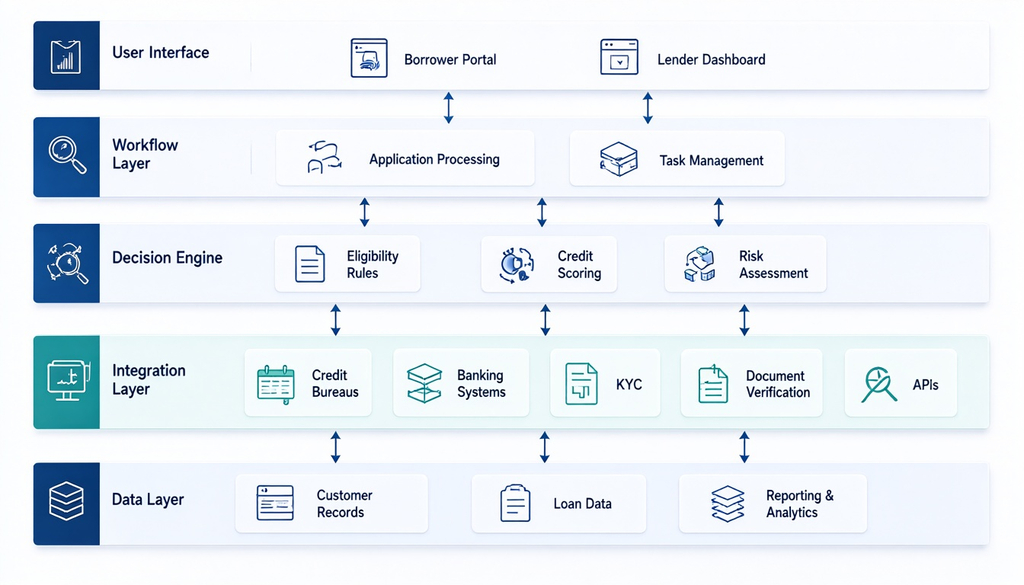
A loan origination system architecture describes how different components, applications and services work together to process loan applications.
A typical architecture may contain the following layers.
1. User interface layer
This is where customers, loan officers, credit analysts and other authorised employees interact with the platform.
It may include web portals, mobile applications and internal dashboards.
2. Application and workflow layer
This layer manages application records, workflow stages, task assignments, approval routing and status tracking.
3. Business rules and decision engine
The rules engine applies configured eligibility criteria and lending policies.
Depending on the implementation, it may support automated decisions, risk flags and referral rules.
4. Integration layer
The integration layer connects the LOS with external and internal systems through APIs or other supported interfaces.
These may include:
- Credit bureaus
- KYC and identity verification providers
- Bank statement analysis services
- Document management systems
- E-signature platforms
- Core banking systems
- Payment and disbursement systems
5. Data and reporting layer
This layer stores or accesses application information, manages records and supports operational reporting.
The exact architecture depends on whether the platform is cloud-based, on-premises or delivered through a hybrid deployment.
Architecture consideration: Lenders should evaluate data security, access controls, encryption, integration reliability, auditability, scalability and regulatory requirements before selecting a platform.
LOS vs LMS: What is the difference?
A loan origination system and a loan management system support different stages of the lending lifecycle.
| Comparison | Loan Origination System (LOS) | Loan Management System (LMS) |
|---|---|---|
| Main purpose | Manages loan application and approval | Manages the loan after origination |
| Starting point | Loan application | Loan account creation or booking |
| Key activities | Verification, credit assessment, underwriting and approval | Repayment tracking, interest calculation and servicing |
| Main users | Sales teams, credit analysts and underwriters | Operations, servicing and collections teams |
| Typical output | Approved loan ready for disbursement | Serviced and monitored loan account |
Some financial technology platforms offer both capabilities, while others specialise in one part of the lending lifecycle.
The choice depends on the lender’s operating model, existing systems and technology strategy.
Types of loan origination systems
Different lenders have different workflows and risk requirements. Therefore, loan origination software may be designed or configured for specific lending segments.
| Type | Typical use |
|---|---|
| Mortgage loan origination system | Home loans and mortgage lending |
| Consumer loan origination system | Personal loans and other consumer credit |
| Retail loan origination system | Individual and retail customer lending |
| Commercial loan origination system | Business and commercial lending |
| Corporate loan origination system | Lending to larger companies and institutions |
| Small business loan origination system | Loans for small and medium-sized businesses |
| Digital loan origination system | Online-first application and processing journeys |
A commercial loan origination system may require more complex financial analysis, collateral evaluation, documentation and approval structures than a straightforward personal loan workflow.
Similarly, a mortgage LOS may need to support property valuation, title-related checks, mortgage documentation and additional verification stages.
Loan origination system integrations
An LOS rarely operates in isolation. It usually needs to exchange information with several systems throughout the lending journey.
| Integration | Purpose |
|---|---|
| Credit bureau | Credit history and repayment information |
| KYC provider | Identity verification |
| Bank statement analysis | Income and cash-flow assessment |
| Document management | Document storage and retrieval |
| OCR tools | Data extraction from documents |
| Rules engine | Eligibility and decision rules |
| E-signature provider | Digital execution of documents |
| Core banking system | Loan booking and account information |
| Payment systems | Disbursement and payment processing |
| Loan management system | Post-disbursement servicing |
For lenders, integration quality can be as important as the LOS software itself.
A platform with a long list of features may still create operational challenges if it cannot connect reliably with the lender’s existing technology environment.
Real-world loan origination system examples
Real-world implementations help illustrate how lenders use digital lending platforms, workflow automation and integrations to improve the loan origination process.
The following examples are based on publicly available case studies and company-published information. They should be treated as reported implementation outcomes rather than universal performance benchmarks.
1. Digital transformation at a public sector bank
KPMG describes a digital transformation programme for a leading public sector bank.
The programme focused on improving lending journeys across retail, MSME and agricultural products.
According to KPMG’s published case study:
- The bank reduced lead-to-disbursement turnaround time by approximately 50%.
- 65% of retail loans and 46% of MSME loans were sanctioned through digital channels.
- Digital journeys included analytics-driven and pre-approved customer offers.
The case illustrates how digital application journeys, process redesign and system-based decision-making can improve lending operations.
Read the case study: KPMG – Digital lending transformation case study
2. Atlantic Federal Credit Union and MANTL
Atlantic Federal Credit Union partnered with MANTL to create a more unified digital consumer lending journey.
The implementation brought membership eligibility verification and enrolment into the loan application process.
The published case study reports:
- Consumer loan account opening time, including membership enrolment, reduced from as long as two days to six minutes.
- An 80% personal loan application submission rate.
- Document collection was eliminated for 67% of personal loans booked during the reported 90-day period.
- Automated reminder emails re-engaged 80% of abandoned applications.
The six-minute figure relates to consumer loan account opening, including membership enrolment. It should not be interpreted as the time required for the entire credit assessment, approval and funding lifecycle.
Read the case study: MANTL – Atlantic Federal Credit Union
3. A+ Federal Credit Union and MeridianLink
A+ Federal Credit Union faced the challenge of operating six different platforms for its loan origination activities.
Different systems created inconsistencies across lending products and channels.
The credit union adopted MeridianLink One to consolidate lending workflows and support digital lending, automated decisioning, integrations and reporting.
The case demonstrates why lenders may consider consolidating fragmented systems into a more unified loan origination platform.
Read the case study: MeridianLink – A+ Federal Credit Union
4. SWBC Mortgage and Blend
SWBC Mortgage wanted to move from a paper-heavy application process to a more digital mortgage experience.
Blend worked with SWBC Mortgage on its digital mortgage application journey, integrating with the existing Encompass mortgage LOS.
According to Blend’s published case study:
- The pilot reported a 28% reduction in loan cycle time for loans included in the pilot.
- The national rollout to branches was completed in less than four months.
- The implementation included an integration with Encompass.
This example highlights an important consideration when selecting loan origination system software: lenders may prefer solutions that integrate with existing systems rather than replacing the entire technology environment.
Read the case study: Blend – SWBC Mortgage
5. Mortgage loan origination platform modernisation
Infosys describes a project for a leading bank that wanted to improve the performance of its mortgage loan origination platform.
The work involved replacing a legacy LOS environment with third-party products and supporting implementation, testing and process improvements.
Infosys reports that the programme reduced manual effort by 238 person-hours per 100 loans.
The case highlights how platform modernisation, implementation planning and testing can contribute to more efficient mortgage lending operations.
Read the case study: Infosys – Loan origination platform modernisation
Loan origination system vendors: What should lenders evaluate?
Choosing a loan origination system vendor is an important technology decision.
A lender should not select a platform based only on the number of features or the popularity of a software brand.
The right solution should align with the institution’s loan products, operational requirements, risk policies, integration needs and future growth plans.
Some considerations include:
1. Lending product coverage
Does the platform support the lender’s specific requirements, such as mortgage, retail, consumer, commercial or small-business lending?
2. Workflow configuration
Can the lender configure application stages, approval limits, exception handling and internal credit policies?
3. Integration capabilities
Can the platform connect with existing core banking, credit bureau, KYC, document management and servicing systems?
4. Automation and decisioning
Does the software support rules-based decisioning, automated document processing and workflow routing?
5. Security and compliance
Does the provider support the lender’s security, privacy, audit and regulatory requirements?
6. Scalability
Can the platform handle increasing application volumes, new products and additional lending channels?
7. Implementation and support
What are the implementation timelines, migration requirements, training arrangements and ongoing support commitments?
Examples of LOS platforms and technology providers
The lending technology market includes specialised providers and broader financial technology platforms. Examples that appear in lender and industry research include:
- MeridianLink
- ICE Mortgage Technology and Encompass
- Fiserv
- FIS
- Newgen
- Moody’s
- Oracle
- Blue Sage
- DigiFi
Other product-specific searches include Empower, Fuse, Arive, Jupiter, Byte, defi, NetOxygen and Black Knight.
These names should not automatically be treated as directly interchangeable products. Their capabilities, target lending segments, ownership and product positioning can differ. Lenders should verify current product documentation and suitability before shortlisting vendors.
Loan origination system RFP: Questions to ask before selecting software
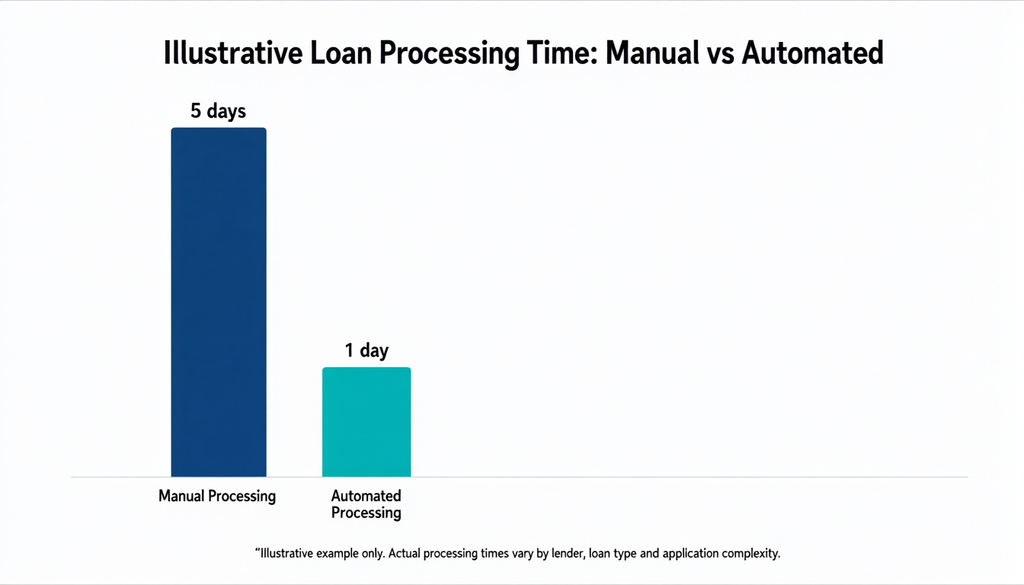
A request for proposal (RFP) helps lenders compare technology providers against defined business and technical requirements.
A loan origination system RFP may include questions such as:
| Evaluation area | Questions to ask |
|---|---|
| Loan products | Which loan types and lending workflows does the platform support? |
| Application channels | Can applications be submitted through branches, websites, mobile apps and partners? |
| Credit assessment | Can the system support lender-defined underwriting rules? |
| Integrations | Which APIs and third-party integrations are available? |
| Document management | Does the platform support document collection, validation and e-signatures? |
| Reporting | Can teams monitor application volumes, rejection reasons and turnaround times? |
| Security | What access controls, encryption and audit capabilities are available? |
| Implementation | What are the expected timelines, dependencies and migration requirements? |
| Pricing | What are the licensing, implementation, maintenance and integration costs? |
| Support | What training, service levels and technical support are provided? |
A structured RFP makes it easier to compare providers on business fit rather than relying solely on product demonstrations.
Common challenges in loan origination system implementation
Although an LOS can improve lending operations, implementation requires careful planning.
Legacy system integration
Banks and financial institutions may already use several systems for customer data, credit assessment, documentation and loan servicing.
Connecting these systems can be complex, particularly when older platforms have limited integration capabilities.
Data quality and consistency
Incomplete, duplicated or inaccurate borrower information can affect verification and underwriting.
Lenders need clear data validation processes and ownership.
Workflow complexity
Different loan products may require different documents, checks, approval authorities and risk policies.
A one-size-fits-all workflow may not suit every lending segment.
Change management
Employees may need training to adapt to new systems and revised processes.
Technology implementation should therefore include user training, process documentation and operational support.
Security and regulatory requirements
Loan origination platforms process sensitive personal and financial information.
Lenders must evaluate data protection, access management, audit trails, retention requirements and applicable regulatory obligations.
How to evaluate the best loan origination system for your business
The best loan origination system depends on the lender’s size, products, technology environment and operating model.
A small digital lender may prioritise rapid deployment and automated application processing.
A large bank may require complex approval hierarchies, extensive integrations, advanced reporting and support for multiple lending products.
Before choosing a platform, lenders should:
- Map the existing loan origination process.
- Identify delays, manual activities and operational bottlenecks.
- Define requirements for each loan product.
- Evaluate software capabilities and integration options.
- Request demonstrations using realistic lending scenarios.
- Compare implementation costs and support arrangements.
- Assess security, compliance and scalability.
- Run a pilot before a wider rollout, where appropriate.
A vendor demonstration should cover the complete journey, from application submission to approval and handover for disbursement—not just the software dashboard.
Frequently asked questions about loan origination systems
1. What is a loan origination system used for?
A loan origination system is used to manage the loan application process, including customer onboarding, document collection, verification, credit assessment, underwriting, approval and preparation for disbursement.
2. What is the difference between a loan origination system and loan management system?
An LOS manages the loan application and approval stages. An LMS generally manages the loan after it has been originated, including repayment tracking, interest calculation and servicing.
3. What is loan origination system software?
Loan origination system software is a digital platform that helps lenders manage and coordinate the activities involved in processing loan applications.
4. What is a digital loan origination system?
A digital loan origination system enables borrowers and lenders to complete some or most application and processing activities through digital channels, reducing reliance on paper-based workflows.
5. What are the main features of a loan origination system?
Common features include application management, document collection, verification, credit bureau integration, underwriting workflows, rules engines, approval routing, reporting and system integrations.
6. What is a commercial loan origination system?
A commercial loan origination system supports lending to businesses and organisations. It may handle more complex financial analysis, collateral assessment, documentation, risk evaluation and approval requirements.
7. What is loan origination system architecture?
Loan origination system architecture describes the software components, data layers, workflow engines and integrations that work together to process loan applications.
8. Can a loan origination system automate credit decisions?
Some LOS platforms support automated decisioning through configurable rules and integrations. However, automation depends on the lender’s policies, product requirements and implementation. Complex or exceptional applications may still require manual underwriting.
9. What should lenders look for in loan origination system vendors?
Lenders should evaluate product coverage, workflow flexibility, integration capabilities, automation, security, compliance, implementation support, scalability and total cost of ownership.
10. Is a loan origination system suitable for NBFCs and fintech lenders?
Yes. An LOS can support banks, NBFCs, fintech lenders, credit unions and other lending institutions. The required features and implementation approach will vary by organisation.
Conclusion
A loan origination system plays an important role in modern lending by bringing application processing, document verification, credit assessment, underwriting and approval workflows into a more structured environment.
For banks, NBFCs, credit unions and fintech lenders, the right loan origination system software can improve process visibility, reduce repetitive manual activities and create a more consistent borrower experience.
However, successful implementation involves more than choosing a software platform. Lenders must also consider workflow design, data quality, system integrations, security, regulatory requirements and employee adoption.
As digital lending continues to evolve, loan origination systems will remain an important part of the technology infrastructure supporting faster, more connected and more scalable lending operations.
Disclaimer
This article is intended for educational and informational purposes only. The loan origination processes, technologies and examples discussed are based on publicly available information and may vary across financial institutions, lenders and technology providers.
Case studies and performance figures are based on information published by the respective organisations or technology providers and should not be interpreted as guaranteed results or independently verified benchmarks.
This article does not constitute financial, legal, regulatory or technology procurement advice. Readers should conduct their own research and consult relevant professionals before making business or technology decisions.






Leave a Reply