


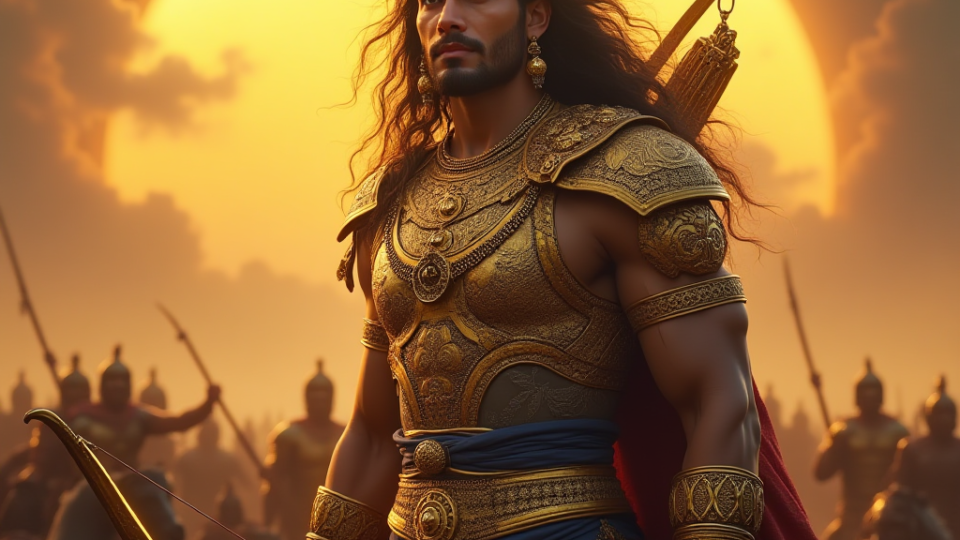
Karna-The Complete Story of the Greatest Warrior of Mahabharata
Discover the complete story of Karna from the Mahabharata, from his miraculous birth to his heroic death. Learn about his friendship with Duryodhana, his divine armor, the curses that shaped his destiny, and the life lessons that still inspire millions today.
Who Was Karna?
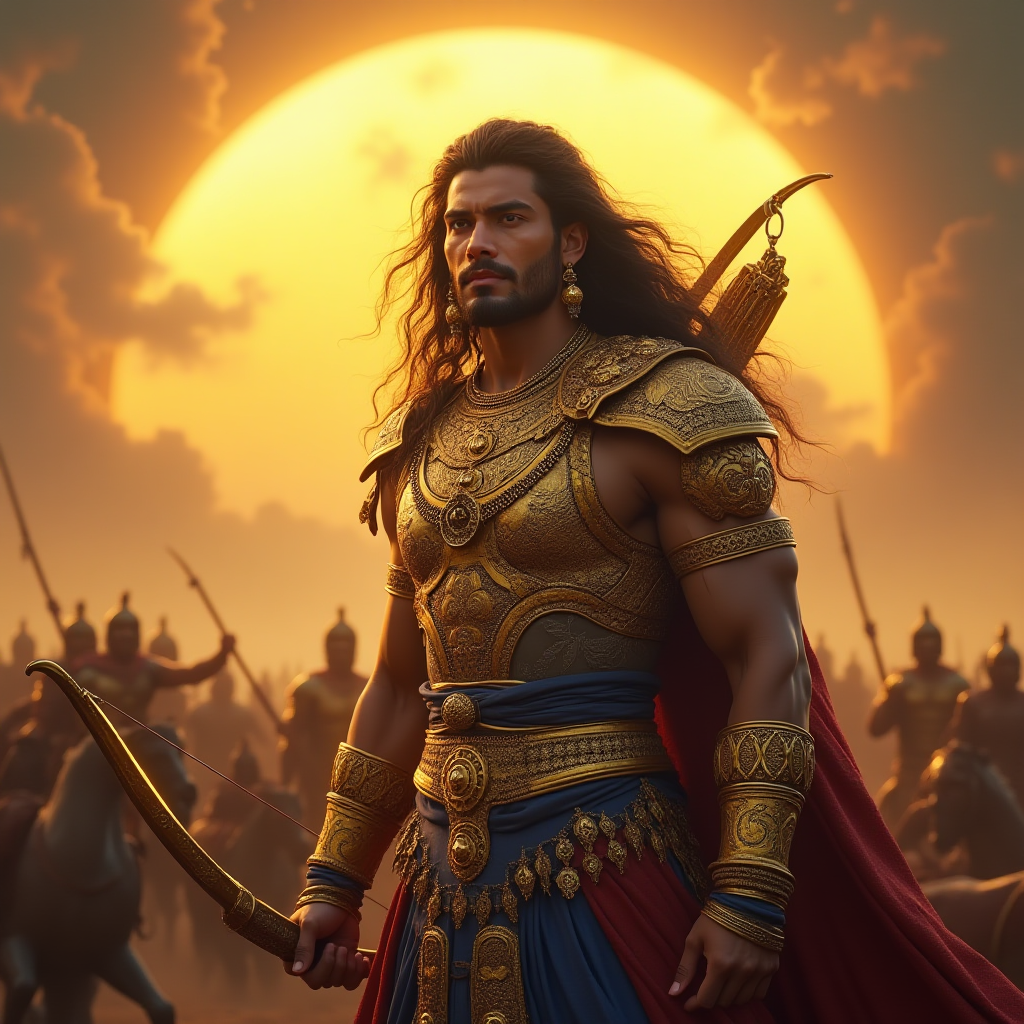
Among all the legendary heroes of the Mahabharata, few characters evoke as much admiration, sympathy, and respect as Karna. He was a warrior of unmatched courage, an archer of extraordinary skill, a king known for his generosity, and a friend whose loyalty never wavered. Yet despite his greatness, Karna spent his entire life battling circumstances beyond his control.
Born with divine blessings, abandoned as an infant, rejected because of his upbringing, cursed despite his dedication, and forced to fight against his own brothers without knowing the truth for most of his life, Karna’s story is one of the most emotional and unforgettable journeys in Indian mythology.
He was never crowned emperor. He never enjoyed the love of his birth family. Yet thousands of years later, he is remembered with deep reverence as Danveer Karna-the greatest giver.
This is the complete story of Karna, one of the most remarkable figures in the Mahabharata.
The Divine Birth of Karna
Long before the Kurukshetra War, Princess Kunti served the great sage Durvasa with sincerity and devotion. Impressed by her humility and dedication, the sage blessed her with a powerful mantra.
The mantra carried an extraordinary promise. Whenever Kunti chanted it with faith, any deity she invoked would appear before her and bless her with a child possessing divine qualities.
Young and curious, Kunti wondered whether the mantra truly held such power. At sunrise, she stood in prayer and invoked Surya, the Sun God.
To her amazement, Surya appeared before her in radiant golden light. Startled, Kunti explained that she had only wished to test the mantra. Surya gently reassured her that his blessing would not diminish her honor or purity.
Soon afterward, Kunti gave birth to a beautiful baby boy.
The child was unlike any ordinary infant. He was born wearing a natural golden armor known as the Kavacha and shining earrings called the Kundala. These celestial gifts made him almost invincible and symbolized his divine origin.
The child was destined for greatness.
Watch the Complete Story of Karna
If you enjoy reading about Karna’s extraordinary life, you can also watch the complete story in video format. This video takes you through Karna’s journe-from his miraculous birth and unmatched generosity to his unwavering loyalty and heroic end on the battlefield of Kurukshetra.
▶ Watch the full video here: CLICK HERE!
Whether you are a parent sharing Indian mythology with your children, a student learning about the Mahabharata, or simply a mythology enthusiast, this video brings Karna’s inspiring story to life with engaging visuals and narration.
A Mother’s Heartbreaking Decision

Although Kunti loved her son deeply, she faced an impossible choice.
She was unmarried, and in those times society judged unmarried mothers harshly. Fear of disgrace and the consequences for her family overwhelmed her.
With tears filling her eyes, she wrapped the newborn carefully in soft cloth, placed him inside a sturdy basket, and prayed for his safety.
Then she gently set the basket afloat on the river.
As the current carried her baby away, Kunti watched helplessly from the riverbank. Her heart broke, but she trusted that the gods would protect the innocent child.
Neither mother nor son knew that this painful separation would shape the destiny of kingdoms and become one of the greatest tragedies of the Mahabharata.
A New Beginning
The basket floated downstream until it was found by Adhiratha, the royal charioteer of King Dhritarashtra, and his wife Radha.
The couple had long prayed for a child.
When they saw the radiant infant wrapped in fine cloth and adorned with golden armor, they believed the gods had answered their prayers.
They lovingly adopted the child and named him Karna.
Although they were not his biological parents, they raised him with boundless love and affection. Karna never considered them anything less than his true mother and father.
Growing up in their humble home, Karna learned kindness, humility, honesty, and respect. His upbringing taught him that greatness comes not from birth but from character.
Yet one dream burned brightly in his heart.
He wanted to become the greatest archer in the world.
A Dream That Faced Rejection
As Karna grew older, stories of the royal princes of Hastinapura inspired him. Among them, Arjuna stood out as the finest student of the great teacher Dronacharya.
Determined to master archery, Karna approached Dronacharya with hope and humility, asking to become his disciple.
But Dronacharya refused.
Believing Karna to be the son of a charioteer, he denied him the opportunity to learn the advanced techniques reserved for princes and warriors.
The rejection wounded Karna deeply.
For many people, such disappointment would have ended their dream.
For Karna, it became the beginning of an even greater determination.
He trained alone for endless hours, practicing with unwavering discipline. He shot arrows until his fingers bled, strengthened his body through relentless effort, and transformed every insult into motivation.
The world had closed one door.
Karna decided he would build another.
Karna Meets Parashurama
Although Karna never gave up on his dream, he knew that becoming the world’s greatest archer required a master who possessed knowledge beyond ordinary warriors.
At that time, the legendary sage Parashurama was considered the greatest teacher of warfare. His knowledge of celestial weapons and advanced combat techniques was unmatched. However, Parashurama had taken a solemn vow never to teach Kshatriyas because of his deep resentment toward many kings of his time.
Karna realized that if he revealed his true background, he would likely be rejected once again.
Determined to learn, he approached Parashurama and introduced himself as a humble Brahmin seeking knowledge.
Impressed by Karna’s sincerity, discipline, and eagerness to learn, Parashurama accepted him as a disciple.
For years, Karna trained tirelessly under the great sage. He mastered archery, swordsmanship, mace fighting, and the use of powerful celestial weapons. His dedication amazed everyone around him.
Soon, Karna became one of the finest warriors of his generation.
The Test That Changed Karna’s Destiny
One afternoon, after a long day of training, Parashurama rested with his head on Karna’s lap.
As the sage slept peacefully, a venomous insect crawled onto Karna’s leg and began burrowing deep into his thigh.
The pain was unbearable.
Blood flowed freely from the wound.
Every moment felt like fire piercing his flesh.
Yet Karna remained perfectly still.
He feared disturbing his guru’s sleep more than he feared his own suffering.
When Parashurama finally awoke, he noticed blood soaking Karna’s clothes.
He was astonished.
“No ordinary Brahmin could endure such unbearable pain without moving,” he said.
At that moment, Parashurama realized that Karna had hidden his true identity.
Feeling deceived, the sage became angry.
Although he admired Karna’s courage and determination, he believed that truth should never have been concealed.
In his anger, he pronounced a terrible curse.
“When the moment comes when you need your knowledge of divine weapons the most, you shall forget the sacred mantras.”
Those words would one day decide Karna’s fate on the battlefield of Kurukshetra.
The Second Curse
Misfortune continued to follow Karna.
One day, while practicing archery in the forest, he accidentally shot a cow, mistaking it for a wild animal.
The cow belonged to a Brahmin, who was devastated by the loss of his innocent animal.
Despite Karna’s sincere apology, the grieving Brahmin cursed him.
“As my helpless cow died without protection, one day your chariot wheel will become trapped in the earth, and you too shall face death while helpless.”
Once again, destiny turned against Karna.
Though he had acted without malicious intent, another curse became part of his life.
These curses would remain hidden for years, waiting for the moment they would change history forever.
Karna Challenges Arjuna
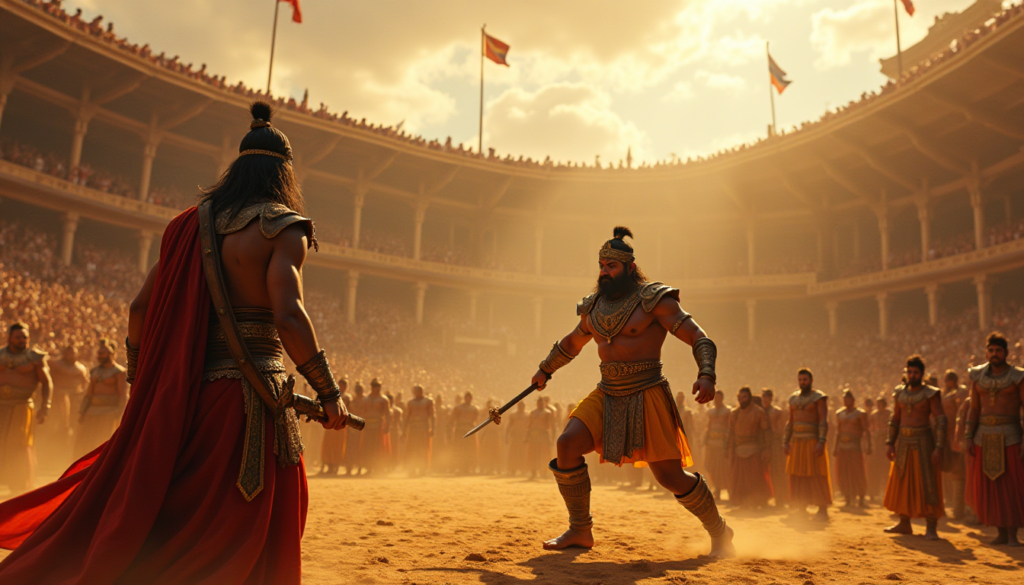
Years later, the royal princes of Hastinapura gathered for a grand tournament to demonstrate everything they had learned under Dronacharya.
Thousands of spectators filled the arena.
Princes, kings, sages, and citizens eagerly watched the young warriors display their remarkable skills.
Among them, Arjuna amazed everyone with his extraordinary mastery of archery.
The audience applauded as arrow after arrow struck its target with incredible precision.
Just as the celebrations reached their peak, a young warrior stepped forward.
It was Karna.
With calm confidence, he repeated every feat Arjuna had performed.
He matched every skill.
Every shot.
Every challenge.
The entire arena fell silent.
Then Karna looked directly at Arjuna.
“I challenge you to a duel.”
The crowd expected admiration for such extraordinary talent.
Instead, questions filled the arena.
“Who is he?”
“What is his family?”
“What is his lineage?”
When it became known that Karna had been raised in a charioteer’s family, many nobles refused to recognize his challenge.
According to the customs of the time, they believed that only a prince could challenge another prince.
Instead of celebrating his remarkable abilities, they mocked his birth.
The humiliation cut deeper than any weapon.
The Friendship That Changed Everything
As the crowd insulted Karna, one man saw not his birth but his greatness.
That man was Prince Duryodhana.
Recognizing Karna’s extraordinary talent, Duryodhana immediately made a bold decision.
He declared Karna the King of Anga.
The royal coronation took place before the entire assembly.
With a crown upon his head, Karna was no longer merely the son of a charioteer.
He was now a king.
No one could question his right to challenge Arjuna.
For Karna, this moment meant far more than receiving a kingdom.
For the first time in his life, someone had believed in him without asking about his birth.
Someone had seen his abilities instead of his background.
From that day onward, Karna pledged his lifelong loyalty to Duryodhana.
Many later criticized this friendship because Duryodhana stood on the side of the Kauravas.
Yet Karna never forgot who had stood beside him when the rest of the world rejected him.
To Karna, loyalty was not a matter of convenience.
It was a matter of honor.
Danveer Karna – The Greatest Giver
As the King of Anga, Karna became famous not only for his skill in battle but also for his unmatched generosity.
Every morning, after offering prayers to Surya, he welcomed anyone who sought charity.
No request was considered too great.
He gave away gold.
Jewels.
Land.
Cattle.
Horses.
Food.
Precious ornaments.
If someone asked for help, Karna never turned them away.
His generosity became legendary throughout the kingdom.
People began calling him Danveer Karna, meaning “Karna, the greatest among all givers.”
For Karna, wealth was never meant to be collected.
It was meant to be shared.
His reputation spread far beyond the borders of Anga, inspiring admiration even among those who disagreed with his choices.
Yet destiny still had its greatest test waiting for him.
Krishna Reveals the Truth
As the great Kurukshetra War drew closer, Lord Krishna knew that Karna’s presence on the Kaurava side would make the conflict even more devastating.
Before the war began, Krishna met Karna privately.
It was one of the most emotional conversations in the Mahabharata.
Krishna revealed the truth that Karna had been denied his entire life.
“You are not the son of a charioteer,” Krishna said.
“You are Kunti’s firstborn son. The Pandavas are your younger brothers.”
For a moment, Karna stood speechless.
Everything he believed about his identity changed in an instant.
The questions that had haunted him since childhood finally had answers.
Krishna then made Karna an extraordinary offer.
“If you join the Pandavas, you will become the eldest brother. The throne of Hastinapura will be yours, and your brothers will gladly accept you.”
It was an offer of power, respect, and the family Karna had always longed for.
But Karna gently refused.
He replied,
“Duryodhana stood beside me when the whole world rejected me. I cannot abandon him now, simply because I have learned the truth.”
Karna knew that choosing Duryodhana might cost him his life.
Still, he chose loyalty over power.
Kunti’s Emotional Plea
After Krishna’s meeting, Kunti herself approached Karna.
She met him at sunrise as he offered prayers to Surya.
With tears in her eyes, she confessed the truth.
“I am your mother.”
She begged Karna to leave Duryodhana and join the Pandavas.
Karna listened quietly.
There was no anger in his voice.
Only sadness.
He answered,
“Mother, if you had accepted me when I was born, my life would have been very different. But today, I cannot betray the man who trusted me when everyone else rejected me.”
Yet Karna could not ignore the pain before him.
He made Kunti a promise.
“I will not kill any of your sons except Arjuna. No matter what happens, you will still have five sons.”
It was both a promise and a heartbreaking farewell.
The Greatest Act of Charity
The gods knew that Karna’s divine armor and earrings made him nearly impossible to defeat.
Indra, the king of the gods and father of Arjuna, decided to test Karna’s generosity.
Disguised as an old Brahmin, he approached Karna during his daily charity.
“I seek your golden armor and earrings,” the old man requested.
Karna immediately recognized him.
He knew the old Brahmin was Indra in disguise.
He also knew that removing the armor would leave him vulnerable in battle.
Even so, Karna smiled.
“If this is what you desire, I shall gladly give it.”
Without hesitation, Karna removed the armor and earrings that had protected him since birth and offered them as charity.
Even Indra was moved by such selflessness.
Revealing his true form, he praised Karna’s generosity and gifted him the divine weapon Vasavi Shakti.
However, the weapon could only be used once.
Karna accepted the gift with gratitude.
He had once again proven why the world called him Danveer Karna.
Karna in the Kurukshetra War
When the Kurukshetra War began, Karna fought with unmatched courage.
His arrows struck like lightning.
His skill terrified even the greatest warriors.
For several days, he defeated powerful opponents and protected Duryodhana’s army from destruction.
During one fierce night battle, the mighty warrior Ghatotkacha created chaos among the Kaurava forces using his magical powers.
Realizing that countless soldiers would perish if Ghatotkacha remained alive, Karna made a difficult decision.
He used the divine Vasavi Shakti.
The celestial weapon struck Ghatotkacha, ending his life.
Although Karna saved the Kaurava army, he had now lost the only weapon capable of defeating Arjuna.
His final battle would have to be fought without it.
The Final Battle
The long-awaited duel between Karna and Arjuna finally arrived.
The battlefield fell silent as the two greatest archers faced each other.
Arrows filled the sky.
Every strike shook the earth.
Neither warrior gave an inch.
Then destiny intervened.
Karna’s chariot wheel suddenly became trapped in the ground.
The curse given years earlier had come true.
As Karna struggled to free the wheel, he tried to remember the sacred mantras taught by Parashurama.
But another curse took effect.
The mantras disappeared from his memory.
For the first time, Karna stood helpless.
He appealed to Arjuna.
“Wait until I free my chariot. Then we shall continue the battle.”
Krishna reminded Arjuna of the many injustices committed during the war and urged him not to delay.
Arjuna released his arrow.
It struck Karna.
The great warrior fell upon the battlefield.
One of the finest heroes of the Mahabharata had reached the end of his journey.
The Truth After the War
Only after the war did the Pandavas learn the truth.
Karna had been their elder brother all along.
The revelation filled them with sorrow.
Yudhishthira was devastated.
Arjuna could hardly believe that the warrior he had fought and admired was his own brother.
Kunti wept for the son she had lost twice.
First as an infant.
Then on the battlefield.
Victory could never erase that grief.
What Can We Learn from Karna?
Karna’s life teaches lessons that remain relevant even today.
1. Greatness Is Not Determined by Birth
Although people judged Karna because of his upbringing, he proved that talent, dedication, and character matter far more than social status.
2. Hard Work Overcomes Obstacles
Repeated rejection never stopped Karna from pursuing excellence.
His determination transformed him into one of history’s greatest warriors.
3. Loyalty Is a Powerful Virtue
Karna remained loyal to Duryodhana because he valued gratitude above personal gain.
Whether one agrees with his decision or not, his loyalty remains one of his defining qualities.
4. True Generosity Has No Limits
Karna gave without expecting anything in return.
His generosity continues to inspire people centuries later.
5. Every Choice Has Consequences
Karna’s life also reminds us that even noble people can make difficult choices whose consequences shape history.
Interesting Facts About Karna
- Karna was the eldest son of Kunti.
- He was the son of Surya, the Sun God.
- He was born with divine armor and earrings.
- He was adopted by Adhiratha and Radha.
- He became the King of Anga.
- He learned warfare from Parashurama.
- He was cursed more than once during his lifetime.
- He was famous throughout the land for his generosity.
- He remained loyal to Duryodhana until the very end.
- After the war, the Pandavas discovered he was their elder brother.
Frequently Asked Questions
Why is Karna called Danveer Karna?
Because he never refused anyone who came to him seeking charity, even when it meant sacrificing his own safety.
Who were Karna’s real parents?
Karna was the son of Princess Kunti and Surya, the Sun God.
Who raised Karna?
He was lovingly raised by Adhiratha, the royal charioteer, and his wife Radha.
Why did Dronacharya reject Karna?
Dronacharya believed Karna was the son of a charioteer and refused to teach him the highest skills reserved for princes.
Why did Karna support Duryodhana?
Because Duryodhana believed in Karna when everyone else rejected him and gave him the kingdom of Anga.
Who killed Karna?
Karna was killed by Arjuna during the Kurukshetra War after his chariot wheel became stuck in the ground and the curses placed upon him took effect.
Conclusion
Karna’s story is not simply the story of a warrior.
It is the story of a man who spent his entire life searching for acceptance.
He experienced rejection, hardship, and heartbreak, yet he never abandoned his courage or generosity.
His loyalty earned admiration.
His charity became legendary.
His determination inspired generations.
Although fate denied him victory, it could never take away his honor.
That is why, after thousands of years, Karna continues to be remembered not only as one of the greatest warriors of the Mahabharata but also as a symbol of courage, gratitude, sacrifice, and limitless generosity.
His life reminds us that true greatness is measured not by the throne we sit on or the battles we win, but by the values we uphold and the kindness we show to others.
Leave a Reply